Bambu Lab P2S vs Bambu Lab X2D
Verdict
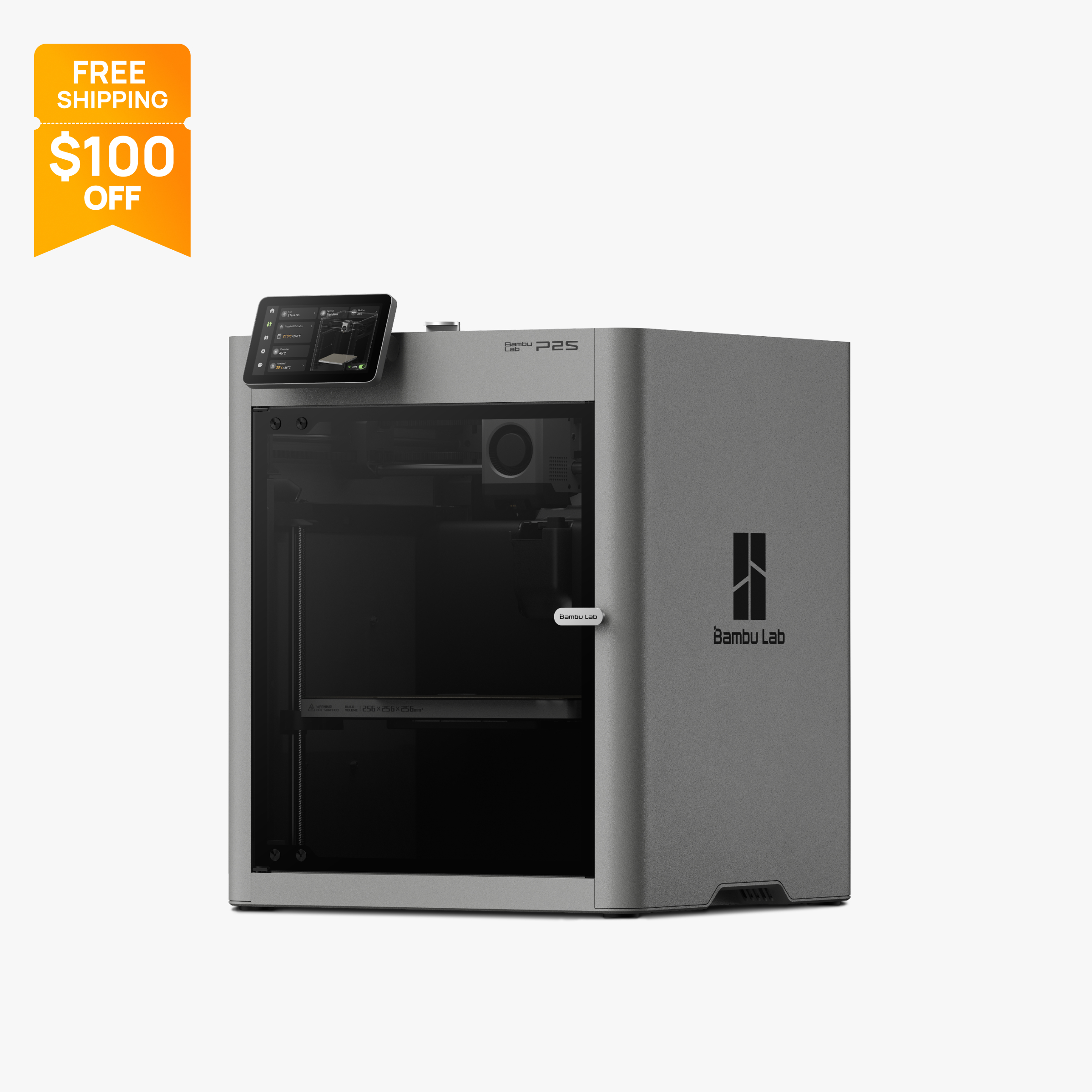
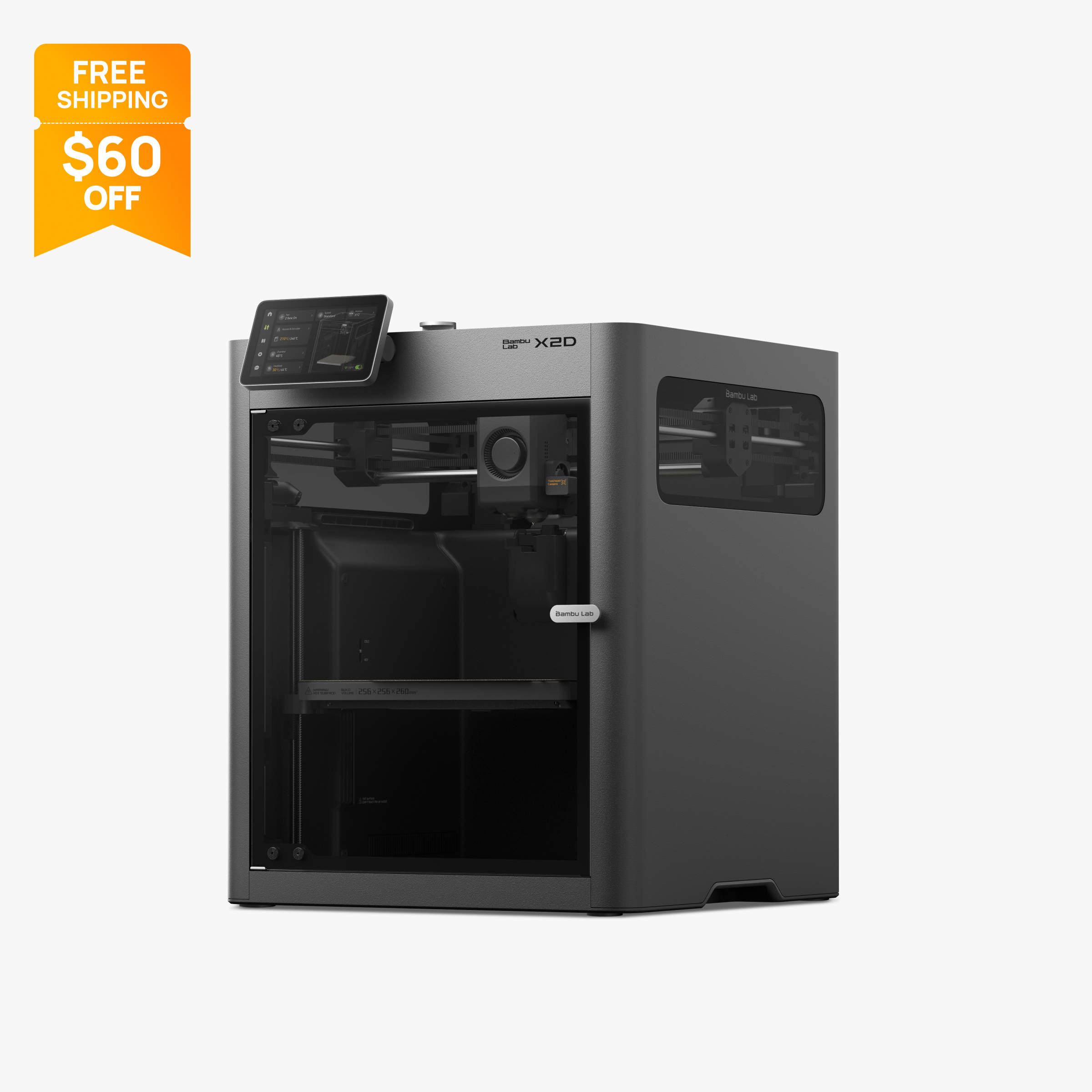
For P2S vs X2D, pick the P2S if one nozzle and a passive enclosure cover your PLA, PETG, ABS and CF prints and you want to spend less. Pick the X2D if you want dual nozzles for support or mixed materials, active chamber heating to 65 °C, 1000 mm/s and HEPA filtration.
Specs side by side
| Spec | Bambu Lab P2S | Bambu Lab X2D |
|---|---|---|
| Type | FDM | FDM |
| Price | $449 | $589 |
| Build volume | 256×256×256 mm | 256×256×260 mm |
| Max speed | 600 mm/s | 1000 mm/s |
| Multicolor | Yes (AMS 2 Pro / AMS HT (optional; AMS 2 Pro included in the P2S Combo; up to 8 units and 20 colors)) | Yes (Dual nozzle; AMS 2 Pro / AMS HT optional (one AMS 2 Pro in the AMS Combo); up to 25 colors per Bambu) |
| Enclosed | Yes | Yes |
| Auto bed leveling | Yes | Yes |
| Connectivity | Dual-band Wi-Fi, USB | Dual-band Wi-Fi, USB |
| Noise | Not listed | Not listed |
| Release year | Not listed | Not listed |
Quick answer
P2S vs X2D comes down to one nozzle or two, and a passive chamber or a heated one. At the time of writing (October 2026), the Bambu Lab P2S is $449 on a Black Friday sale (typical $549) and the Bambu Lab X2D is $589 on sale (typical $649), both for the printer alone. Pick the P2S if you print PLA, PETG, ABS, ASA and carbon fiber filaments one material at a time and want the lower price. Pick the X2D if you want a second nozzle for support material or mixed materials, active chamber heating to 65 °C for large ABS and nylon parts, a 1000 mm/s top speed and HEPA filtration. Both share a hardened steel 300 °C hot end and a 256 mm class build volume.
Key differences
Single nozzle vs dual nozzle
The X2D carries two hot ends: a main nozzle and an auxiliary nozzle. Bambu's store says the second nozzle can print support in its own material for cleaner removal, combine PLA and TPU in one part, and reduce purge waste during color changes, because two filaments can be loaded at once instead of swapped every layer.
The two nozzles are not equal. The main extruder uses a PMSM servo motor and the auxiliary one a stepper motor. Bambu says auxiliary nozzle print quality is slightly lower than the main nozzle, recommends official Bambu filament on it, and applies flow dynamics calibration to the main nozzle only. Printing with the auxiliary nozzle or both nozzles also narrows the usable width from 256 mm to 235.5 mm.
The P2S has one hardened steel nozzle, also driven by a PMSM servo extruder. Every color or material change on the P2S goes through the AMS with a purge, which is fine for occasional multicolor but adds waste and time on prints with many swaps. If you print single-material functional parts most days, the second nozzle may sit unused; if you want soluble or breakaway support, or flexible and rigid material in one part, it is the X2D's main reason to exist.
Chamber heating: passive vs 65 °C active
This is the second big split. The X2D's spec sheet lists active chamber heating up to 65 °C. The P2S has no chamber heater: the store's "50°C Chamber Ready" headline refers to heat held in by the enclosure and an automatic flap that switches between internal and external air circulation, and Bambu's FAQ confirms there is no active heating.
Why it matters: ABS, ASA, PA (nylon) and PC shrink as they cool, and a warm, controlled chamber reduces warping and layer splitting on large parts. Small ABS parts often print fine in a passive enclosure, which is why Bambu lists ABS and ASA as supported on the P2S. Large, tall engineering parts are where an actively heated chamber pays off.
If you print mainly PLA and PETG, a heated chamber offers little benefit, and these materials generally prefer a cooler enclosure. If engineering filaments are central to your work, the X2D is the stronger fit.
Speed and motion
Bambu lists 1000 mm/s top speed for the X2D and 600 mm/s for the P2S. Acceleration is the same on both at 20,000 mm/s², and both list a rated hot end flow of 40 mm³/s with the standard hot end. The X2D adds an optional high flow hot end rated at 65 mm³/s.
In practice, matching acceleration and standard flow mean the gap on small and medium parts is narrower than the top speed numbers suggest; top speed matters most on long, straight moves and large infill areas. The optional high flow hot end is the more meaningful speed upgrade on the X2D for big, simple parts.
Bed, build volume and materials
Bed temperature is 120 °C on the X2D and 110 °C on the P2S. Both are high enough for ABS and ASA; the X2D's extra 10 °C helps with PC and some nylons.
Build volume is 256 x 256 x 256 mm on the P2S and 256 x 256 x 260 mm on the X2D with the main nozzle. With the auxiliary nozzle or both nozzles, the X2D's usable area is 235.5 x 256 x 256 mm, slightly smaller than the P2S.
Both hot ends are hardened steel and reach 300 °C, so both handle carbon and glass fiber filaments. Bambu's X2D list covers fiber-reinforced PLA, PETG, ABS, ASA, PA6, PAHT, PPA and PET on the main hot end, with some grades such as PETG-CF and PA6-CF marked print with caution on the auxiliary hot end. The P2S lists PLA, PETG, ABS, ASA, TPU, PET, PA, PC and PVA, plus PLA-CF, PETG-CF, ABS-GF, PA6-CF and PPA-CF.
Filtration, cameras and indoor use
The P2S uses an activated carbon filter. The X2D adds three-stage filtration: a G3 pre-filter, an H12 HEPA filter and coconut shell activated carbon, targeting both particles and odors. Bambu says the X2D is UL 2904 certified for indoor air quality with its PLA Basic and PETG Basic filaments, and rates it below 50 dB under typical conditions. Bambu does not list a comparable noise figure for the P2S in the spec data we checked.
Both have a 1080p live view camera, door, run-out and tangle sensors and power loss recovery. The X2D adds a 1600 x 1200 toolhead camera. Both have 5-inch touchscreens; the X2D's is 1280 x 720 and the P2S's is 854 x 480.
Size, power and connectivity
Bambu lists the X2D at 392 x 406 x 478 mm and 16.25 kg, with a maximum draw of 1100 W on 110 V circuits during bed warm-up. The P2S weighs 14.9 kg per its spec page. Both have dual-band Wi-Fi, 8 GB of built-in storage and a USB port, and neither has Ethernet. Both work with Bambu Studio, and Bambu says third-party slicers that export standard G-code are supported with some advanced features missing.
Multicolor capacity
Bambu says the P2S supports up to four AMS 2 Pro and four AMS HT units, 20 slots, for up to 20 colors. For the X2D, Bambu lists up to 25-color printing with its dual-nozzle system and AMS units, and connecting more than two AMS units needs a separate 4-in-1 PTFE adapter. For most buyers one 4-slot AMS is plenty; see our best multicolor printers for more.
Price and what you get
Prices were checked on Bambu's US store on October 30, 2026, during a Black Friday sale. Bambu's prices change often, so check the store before buying.
- Bambu Lab P2S, printer only: $449 on sale, typical $549.
- P2S Combo with one AMS 2 Pro: $649 on sale, typical $749.
- Bambu Lab X2D, printer only: $589 on sale, typical $649.
- X2D AMS Combo with one AMS 2 Pro: $789 on sale, typical $899.
- X2D Print More Bundle with two AMS 2 Pro: $1,049. X2D Combo Print with Care Bundle: $836.
At sale prices, the X2D's extra cost buys the second nozzle, active chamber heating, HEPA filtration, a toolhead camera and a higher top speed. Note that the regular prices are closer together than the sale prices, so when the sale ends the X2D's premium over the P2S shrinks. At typical prices, the P2S is $549 and the X2D $649; with one AMS 2 Pro, the P2S Combo is typically $749 and the X2D AMS Combo $899. If you know you want multicolor printing, compare the Combo prices rather than the printer-only prices, since that is what most buyers end up paying. Both fit within our best under $1,000 range, and the P2S also appears in best under $500 territory.
Who should buy which
Buy the P2S if:
- You print one material per job, mostly PLA, PETG, ABS, ASA or carbon fiber blends.
- Your ABS and ASA parts are small to medium, where a passive enclosure is usually enough.
- You want the lower price, or plan to spend the difference on an AMS Combo.
- You are upgrading from a P1S mainly for the hardened nozzle, touchscreen and camera (see P2S vs P1S).
Buy the X2D if:
- You want soluble or breakaway support in its own nozzle, or rigid and flexible material in one part.
- You print large ABS, ASA, nylon or PC parts and want active chamber heating.
- The printer lives indoors near people and you value HEPA filtration.
- You are replacing an X1 Carbon; see X2D vs X1C.
Also consider
- Bambu Lab H2D: dual nozzles and a 65 °C chamber like the X2D, but a 325 x 320 x 325 mm single-nozzle volume and 350 °C nozzles, from $1,399 on sale. Compare in X2D vs H2D.
- QIDI Q2: active chamber heating to 65 °C, a 370 °C nozzle and a 270 x 270 x 256 mm build volume for $499 on QIDI's US store at the time of writing. See QIDI Q2 vs P2S.
- Bambu Lab P1S: the same 256 mm cube for $349 on sale, if you only print PLA, PETG, ABS and ASA.
More options are on our best enclosed 3D printers and best for small business pages.
Frequently asked questions
What is the main difference between the X2D and the P2S?
The X2D has two nozzles and an actively heated chamber that reaches 65 °C, while the P2S has one nozzle and no chamber heater. The X2D also lists 1000 mm/s top speed versus 600 mm/s, a 120 °C bed versus 110 °C, and an H12 HEPA filter.
Is the X2D worth the extra money over the P2S?
It is if you print large ABS, ASA or nylon parts, or want a dedicated support material in a second nozzle. At the time of writing (October 2026) the printer-only X2D was $589 on sale and the P2S $449. If you print mostly PLA and PETG in one material per job, the P2S covers that for less.
Do the P2S and X2D have the same build volume?
Almost. The P2S lists 256 x 256 x 256 mm. The X2D lists 256 x 256 x 260 mm with its main nozzle, but 235.5 x 256 x 256 mm when the auxiliary nozzle or both nozzles print.
Can both printers print carbon fiber?
Yes. Both use hardened steel nozzles and gears rated to 300 °C. On the X2D, Bambu marks some fiber grades such as PETG-CF and PA6-CF as print with caution on the auxiliary nozzle, so use the main nozzle for those.
How many colors can the P2S and X2D print?
Bambu says up to 20 colors on the P2S with up to four AMS 2 Pro and four AMS HT units, and up to 25 colors on the X2D with its dual-nozzle system and AMS units. The X2D needs a 4-in-1 PTFE adapter for more than two AMS units.
Sources
- Bambu Lab P2S technical specifications (official)
- Bambu Lab P2S on the official US store (price, combo contents, FAQ)
- Bambu Lab P2S spec sheet PDF (official, linked from the US store)
- Bambu Lab X2D technical specifications (official)
- Bambu Lab X2D on the official US store (price, bundles, FAQ)
- Bambu Lab US store 3D printer collection (lineup and prices)
- Bambu Lab H2D on the official US store (prices by configuration)
- Bambu Lab P1S on the official US store (price, parameters, FAQ)
- QIDI Q2 on QIDI's US store
- P2S & X2D Heatbed Manual Bed Leveling (Bambu Lab Wiki)