Bambu Lab
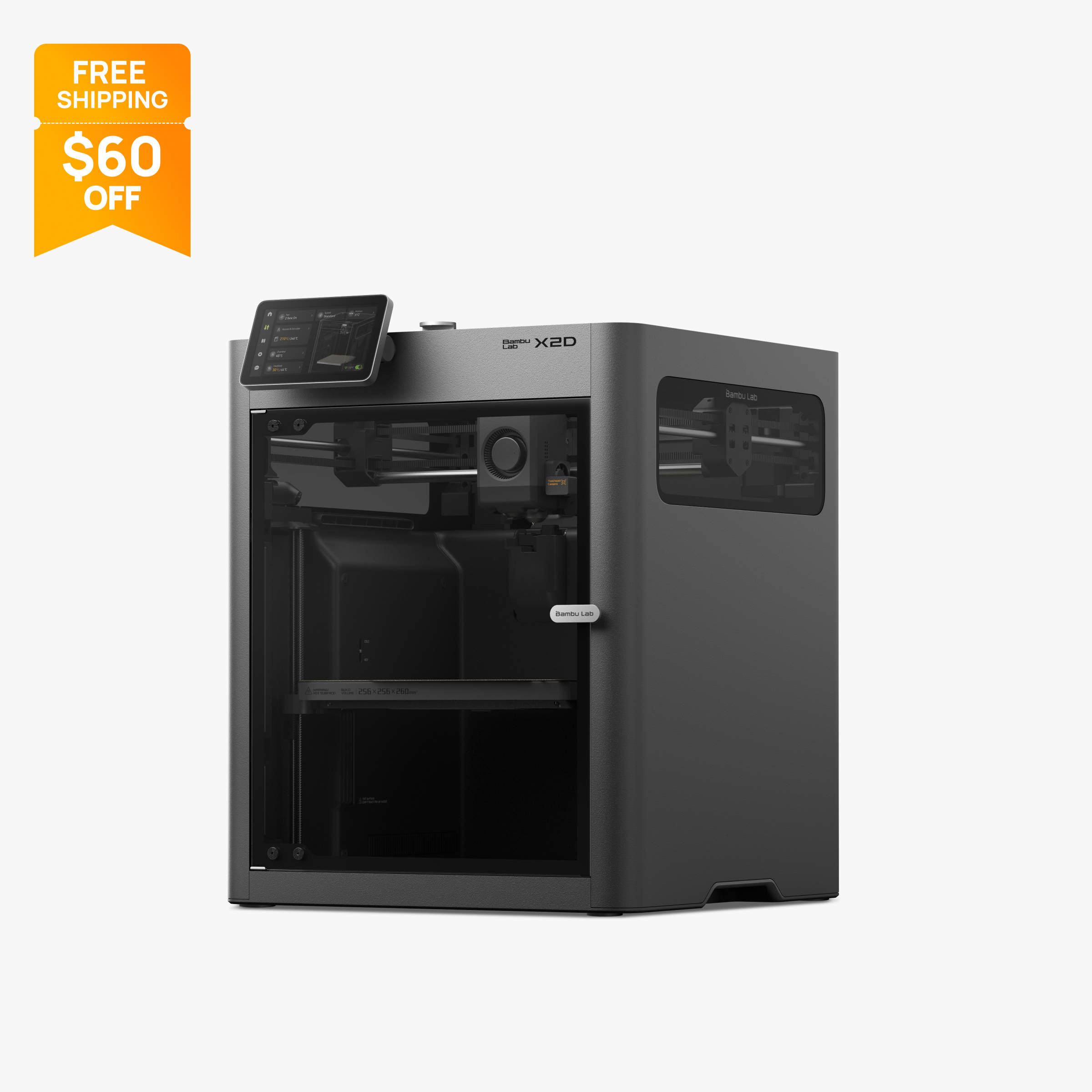
Bambu Lab X2D
Enclosed dual-nozzle 256 mm printer with 65 °C heated chamber, 1000 mm/s and HEPA filtration.
$589Price checked October 30, 2026
Best for Engineering filaments like ABS, ASA and nylonBest for Multi-material prints with dissolvable or breakaway supportBest for Replacing an X1 CarbonBest for Small businesses printing indoors
Overview
The Bambu Lab X2D is an enclosed dual-nozzle CoreXY printer with a 256 x 256 x 260 mm main-nozzle build volume, 1000 mm/s top speed and active chamber heating to 65 °C. Bambu describes it as the X1 Carbon's next chapter; it adds a second nozzle, active chamber heating and a toolhead camera.
What it is
The Bambu Lab X2D is an enclosed dual-nozzle CoreXY 3D printer with a 256 x 256 x 260 mm build volume for the main nozzle and an actively heated chamber. Bambu's US store sells it on its own and in several AMS bundles; this page covers the printer on its own. It takes the place of the Bambu Lab X1 Carbon, which Bambu moved to end of life on March 31, 2026. The X2D store FAQ puts it directly: "X2D is X1C's next chapter."
Comparing the official spec sheets, the X2D doubles the X1 Carbon's top speed from 500 to 1000 mm/s, keeps 20,000 mm/s² acceleration and adds 4 mm of height. It adds a second (auxiliary) nozzle, active chamber heating to 65 °C, a toolhead camera and a three-stage filter with an H12 HEPA layer. Bed temperature is 120 °C; the X1 Carbon spec sheet lists 120 °C on 110 V power and 110 °C on 220 V. Both use a hardened steel nozzle, a 300 °C hot end and a 5-inch 1280 x 720 touchscreen.
Key specs that matter
From Bambu's official X2D spec sheet:
- Build volume: 256 x 256 x 260 mm with the main nozzle; 235.5 x 256 x 256 mm when the auxiliary nozzle or both nozzles print.
- Motion: up to 1000 mm/s and 20,000 mm/s². Rated hot end flow is 40 mm³/s, or 65 mm³/s with the optional high flow hot end.
- Hot ends: two hardened steel nozzles with hardened steel gears, up to 300 °C, 0.4 mm included. The main extruder uses a PMSM servo motor; the auxiliary extruder uses a stepper motor.
- Bed and chamber: up to 120 °C bed and active chamber heating to 65 °C.
- Air filtration: G3 pre-filter, H12 HEPA filter and coconut shell activated carbon.
- Sensors: 1920 x 1080 live view camera, 1600 x 1200 toolhead camera, door, run-out and tangle sensors, and power loss recovery.
- Electronics: 5-inch 1280 x 720 touchscreen, 8 GB eMMC with a USB port, dual-band Wi-Fi.
Who it suits
The X2D fits makers and small businesses that want engineering filaments and multi-material prints in one machine. Bambu's store says the auxiliary nozzle can print support in its own material for clean removal, combine PLA and TPU in one part, and cut purge waste during color changes. Bambu says it supports up to 25-color printing with AMS units. The heated chamber and HEPA filtration also suit ABS, ASA and nylon users who print indoors. Bambu says the X2D is UL 2904 certified for indoor air quality with its PLA Basic and PETG Basic, and rates it below 50 dB under typical conditions.
What to know before buying
At the time of writing (October 2026), the X2D was $589 on Bambu's US store (typical $649), and the X2D AMS Combo with one AMS 2 Pro was $789 (typical $899).
The two nozzles are not equal. Bambu notes that auxiliary nozzle print quality is slightly lower than the main nozzle, that official Bambu filaments are recommended on it, and that flow dynamics calibration and the servo extruder apply to the main nozzle only. Some materials, including PETG-CF and PA6-CF, are marked "print with caution" on the auxiliary hot end. Connecting more than two AMS units needs a 4-in-1 PTFE adapter.
If you need a larger build volume or hotter nozzle, compare the Bambu Lab H2D. If you do not need two nozzles or a heated chamber, the Bambu Lab P2S shares the 256 mm class build volume for less. See also our best enclosed 3D printers.
Specifications
| Type | FDM |
|---|---|
| Price | $589 |
| Build volume | 256×256×260 mm |
| Max speed | 1000 mm/s |
| Multicolor | Yes (Dual nozzle; AMS 2 Pro / AMS HT optional (one AMS 2 Pro in the AMS Combo); up to 25 colors per Bambu) |
| Enclosed | Yes |
| Auto bed leveling | Yes |
| Connectivity | Dual-band Wi-Fi, USB |
| Noise | Not listed |
| Release year | Not listed |
Pros and cons
Pros
- Active chamber heating to 65 °C helps ABS, ASA and nylon parts, something the X1 Carbon and P2S lack.
- The auxiliary nozzle can print support in a separate material or combine PLA and TPU in one part, per Bambu.
- Bambu rates top speed at 1000 mm/s, double the 500 mm/s listed for the X1 Carbon.
- Three-stage filtration with a G3 pre-filter, H12 HEPA filter and activated carbon targets particles and odors.
- Both nozzles and gears are hardened steel, so carbon and glass fiber filaments are supported on the main hot end.
- At $589 on sale, the printer-only X2D costs well under half the $1,399 base H2D on the same store.
Cons
- Bambu says auxiliary nozzle print quality is slightly lower than the main nozzle, and recommends official filament on it.
- Flow dynamics calibration and the PMSM servo extruder apply to the main nozzle only, according to Bambu's notes.
- Printing with the auxiliary nozzle or both nozzles narrows the usable width to 235.5 mm.
- Connecting more than two AMS units requires a separate 4-in-1 PTFE adapter.
- There is no Ethernet port; network control is dual-band Wi-Fi only, according to the official spec sheet.
- The 300 °C nozzle limit is lower than the 350 °C listed for the larger H2D.
Frequently asked questions
Is the X2D the replacement for the X1 Carbon?
Yes, in practice. Bambu ended X1 series manufacturing and sales on March 31, 2026, and the X2D store FAQ says the X2D is "X1C's next chapter," listing its dual nozzles, heated chamber and servo extruder as the main additions.
Does the X2D have a heated chamber?
Yes. Bambu's spec sheet lists active chamber heating up to 65 °C, alongside a 120 °C bed and a 300 °C nozzle.
Are the two nozzles on the X2D identical?
No. Both are hardened steel and reach 300 °C, but the main extruder uses a PMSM servo motor and the auxiliary one a stepper motor. Bambu notes that print quality from the auxiliary nozzle is slightly lower than the main nozzle, and its spec sheet lists a 235.5 mm print width (versus 256 mm) when the auxiliary nozzle or both nozzles print.
How many colors can the X2D print?
Bambu says the dual-nozzle system supports up to 25-color printing with AMS units. Connecting more than two AMS units requires a 4-in-1 PTFE adapter, and the AMS Combo includes one AMS 2 Pro.
Can the X2D print carbon fiber filament?
Yes. Bambu lists carbon and glass fiber reinforced PLA, PETG, ABS, ASA, PA6, PAHT, PPA and PET for the main hot end. Some fiber grades are marked print with caution on the auxiliary hot end.
Sources
- Bambu Lab X2D technical specifications (official)
- Bambu Lab X2D on the official US store (price, FAQ: "X2D is X1C's next chapter")
- Bambu Lab US store 3D printer collection (lineup prices, P1S still listed)
- The X1 series is EOL (official Bambu Lab blog)
- Bambu Lab X1 Carbon technical specifications PDF (official)
- Bambu Lab P2S technical specifications (official)
- Bambu Lab H2D on the official US store
- P2S & X2D Heatbed Manual Bed Leveling (Bambu Lab Wiki)
Verdict
Buy the X2D if you want a heated chamber, dual nozzles and fiber-ready hardware in a 256 mm class printer at a mid-range price. Look at the H2D if you need a larger build volume or 350 °C nozzle, or the P2S if a single nozzle and passive chamber are enough.
Related printers