QIDI Q2 vs Bambu Lab P2S

Verdict
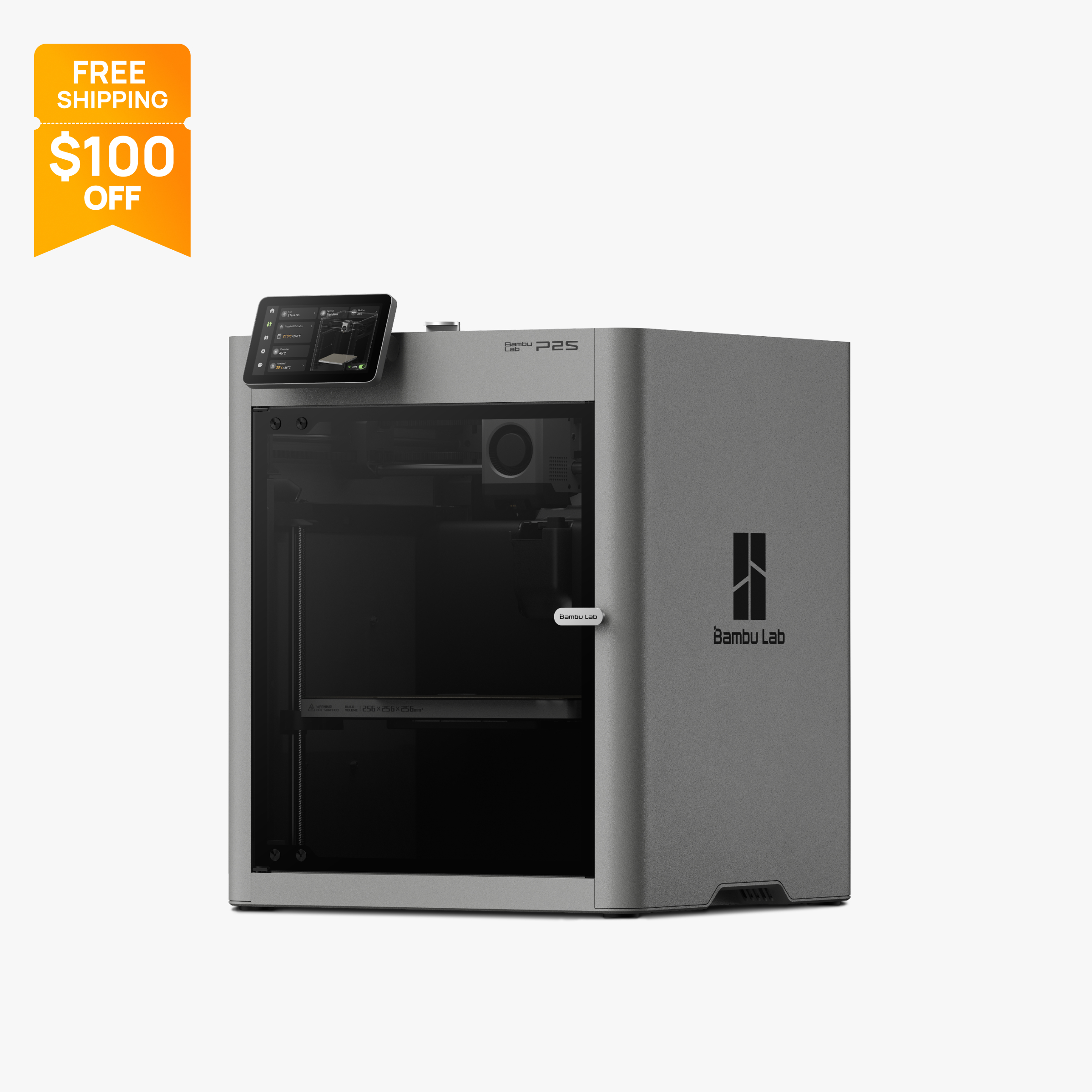
Buy the QIDI Q2 if you print ABS, ASA, PA or PC often: it adds 65 °C active chamber heating, a 370 °C nozzle, a 120 °C bed and Ethernet. Buy the P2S if you mostly print PLA and PETG and want Bambu's multicolor system with up to 20 colors, a 5-inch screen and a 30 fps camera.
Specs side by side
| Spec | QIDI Q2 | Bambu Lab P2S |
|---|---|---|
| Type | FDM | FDM |
| Price | $499 | $449 |
| Build volume | 270×270×256 mm | 256×256×256 mm |
| Max speed | 600 mm/s | 600 mm/s |
| Multicolor | Yes (QIDI Box (optional, sold as Q2 Combo)) | Yes (AMS 2 Pro / AMS HT (optional; AMS 2 Pro included in the P2S Combo; up to 8 units and 20 colors)) |
| Enclosed | Yes | Yes |
| Auto bed leveling | Yes | Yes |
| Connectivity | Wi-Fi 2.4 GHz, Ethernet, USB | Dual-band Wi-Fi, USB |
| Noise | Not listed | Not listed |
| Release year | Not listed | Not listed |
Quick answer
For QIDI Q2 vs P2S, pick the QIDI Q2 if engineering materials are the reason you are buying: it has active chamber heating to 65 °C, a 370 °C nozzle, a 120 °C bed, a slightly larger 270 x 270 x 256 mm build volume, Ethernet and Klipper-based firmware. Pick the Bambu Lab P2S if you mostly print PLA and PETG with some ABS, ASA and carbon fiber, and want a mature multicolor system that scales to 20 colors, a 5-inch touchscreen and a 1080p camera at 30 fps. Both are enclosed CoreXY printers with 600 mm/s and 20,000 mm/s² ratings. At the time of writing, the P2S is cheaper on its own because of a sale, and the two Combos cost the same $649 while Bambu's sale lasts (P2S Combo typical $749).
Key differences
Heated chamber versus passive enclosure
This is the biggest technical difference. QIDI lists second-generation PTC chamber heating on the Q2 that brings the chamber to 65 °C. The P2S is fully enclosed with an activated carbon filter and an automatic flap that switches airflow between internal and external circulation, but Bambu's FAQ confirms it has no active chamber heater. The store's "50°C Chamber Ready" heading describes heat retained by the enclosure, not a heater.
Why it matters: materials such as ABS, ASA, PA and PC shrink as they cool, and a warm, stable chamber reduces warping and layer splitting on larger parts. The Q2's product listing names ABS, ASA, PA and PC among its supported materials, and Tom's Hardware's review of the Q2 Combo reported strong results on high-temperature filaments, including PPS, several PA grades and PC.
Bambu also lists ABS, ASA, PA and PC as supported on the P2S, and its enclosure is enough for most ABS and ASA hobby parts. If you expect to print large nylon or polycarbonate parts regularly, the Q2's heater is the feature to pay for. If those materials are occasional, the P2S covers them well enough.
Hot end, bed and filtration
The Q2 has a 370 °C bimetal nozzle, direct drive with hardened steel gears, and a 120 °C bed. QIDI lists carbon and glass fiber reinforced filaments as supported.
The P2S has a 300 °C hot end with a hardened steel nozzle and hardened steel extruder gear, driven by a PMSM servo motor, and a 110 °C bed. Bambu lists a rated maximum hot end flow of 40 mm³/s and supported fiber grades such as PLA-CF, PETG-CF, ABS-GF, PA6-CF and PPA-CF. QIDI does not list a flow rate in the data used here.
Both printers can handle abrasive filaments without a hardware swap. The Q2's higher nozzle and bed limits give more room for demanding engineering materials, which pairs with its heated chamber.
Filtration also differs. QIDI lists a 3-in-1 system with a G3 pre-filter, H12 HEPA filter and coconut shell activated carbon. Bambu lists an activated carbon filter on the P2S. If fumes and particles in a shared room are a concern, the Q2's listed HEPA stage is a point in its favor.
Build volume and footprint
The Q2's build volume is 270 x 270 x 256 mm, against 256 x 256 x 256 mm on the P2S. That is 14 mm more in X and Y with the same height, which helps with wide flat parts and with fitting more copies on one plate, but it is not a different size class.
QIDI lists the Q2 at 402 x 438 x 494 mm and 18.1 kg net. Bambu's spec page lists the P2S at 14.9 kg net. Either one needs a sturdy table, and the Q2 is the heavier of the two.
Leveling, build plates and nozzle options
QIDI lists a load cell sensor in the Q2's hot end for automatic leveling, and Tom's Hardware's Q2 Combo review reported excellent first layers. The Q2 uses a dual-sided textured PEI plate on an aluminum heated bed. A 0.4 mm nozzle is standard, with 0.2, 0.6 and 0.8 mm options.
The P2S uses a flexible steel plate with a textured PEI surface. Bambu ships a 0.4 mm nozzle and supports 0.2, 0.6 and 0.8 mm sizes, the same range as the Q2. Bambu's wiki also documents a manual bed tramming procedure for the P2S heatbed, which is useful to know if you ever need to service it.
In practice both printers aim to remove manual leveling from everyday use, and both accept the same nozzle sizes, so this is not a deciding factor for most buyers. It does mean switching between fine detail and fast, thick-layer printing is equally possible on either.
Multicolor systems
The P2S works with Bambu's AMS 2 Pro and AMS HT. Bambu's store FAQ says it can connect up to four AMS 2 Pro and four AMS HT units, 20 slots in total, for up to 20 colors. The P2S Combo includes one AMS 2 Pro, which can dry filament; drying during a print needs an official power adapter that is not included.
The Q2 works with the QIDI Box, sold with the printer as the Q2 Combo. Tom's Hardware reported repeated feeding failures with the Box on its Q2 Combo review unit, said it was not sure the Combo is worth the risk for now, and suggested the Box currently works better as a filament dryer. QIDI told the reviewer it was an early unit and that it is working on the issues, though the reviewer reported that a second Box had the same problems.
If multicolor is a main reason to buy, the P2S has the larger and more established system. If you print one color at a time, buy the base Q2 and the Box question does not affect you. Our best multicolor 3D printers page covers more options.
Software, firmware and connectivity
The Q2 runs Klipper-based firmware, according to QIDI's FAQ. QIDI recommends QIDI Studio and also supports OrcaSlicer and PrusaSlicer. For connectivity it lists 2.4 GHz Wi-Fi, Ethernet and USB, plus 32 GB of onboard storage. QIDI's FAQ mentions 5 GHz Wi-Fi while its spec table lists only 2.4 GHz, so plan around 2.4 GHz.
The P2S runs Bambu's firmware and Bambu Studio. Bambu says third-party slicers that export standard G-code, such as PrusaSlicer, SuperSlicer and Cura, are supported, though some advanced features may not be. It lists dual-band Wi-Fi and USB with 8 GB of eMMC, and no Ethernet port.
If you want a wired network connection or already use Klipper and OrcaSlicer, the Q2 fits that setup. If you want a single, integrated ecosystem from slicer to app to filament system, the P2S is the more turnkey choice.
Screen, camera and noise
The P2S has a 5-inch 854 x 480 touchscreen, a 1920 x 1080 camera at 30 fps and a 2 TOPS neural processing unit for AI error detection. The Q2 has a 4.3-inch touchscreen and a camera of up to 1080p with timelapse and AI spaghetti detection. Tom's Hardware also found that the Q2's touchscreen gets in the way when opening the door.
Neither maker lists a noise figure in the data used here. Tom's Hardware described its Q2 Combo as quite loud, and not only from the fans, since Box loading and the filament cutter add noise. There is no matching published figure for the P2S, so this page cannot say which is quieter.
Price and what you get
At the time of writing (late October 2026), QIDI's US store lists the QIDI Q2 at $499 with no sale price shown, and the Q2 Combo with the QIDI Box at $649.
Bambu's US store lists the P2S at $449 for the printer alone during a Black Friday sale (typical price $549), and the P2S Combo with an AMS 2 Pro at $649 (typical $749). Prices change often on both stores, so check before you buy.
So during the sale the P2S is the cheaper printer on its own, while at Bambu's typical prices the Q2 would be the cheaper one. The Combos land at the same $649 at the time of writing. For the money, the Q2 gives you active chamber heating, a hotter nozzle and bed, HEPA filtration, Ethernet and a slightly bigger plate. The P2S gives you a larger screen, a 30 fps camera (QIDI lists no frame rate for the Q2's camera), a bigger multicolor ecosystem and Bambu's software.
QIDI lists a 1-year warranty and a 14-day no-reason return on the Q2. Bambu's US store lists a 2-year warranty and 30-day returns on the P2S at the time of writing.
Who should buy which
Buy the QIDI Q2 if:
- You plan to print ABS, ASA, PA or PC regularly, including larger parts.
- You want active chamber heating, a 370 °C nozzle and a 120 °C bed.
- You prefer Klipper, OrcaSlicer or a wired Ethernet connection.
- You print mostly in one color and can skip the QIDI Box.
Buy the Bambu Lab P2S if:
- You mostly print PLA and PETG, with some ABS, ASA and carbon fiber.
- Multicolor printing matters, now or later, up to 20 colors.
- You want a 5-inch touchscreen and a smooth 30 fps camera.
- You want Bambu Studio and Bambu's app as one integrated system.
Also consider
- The Bambu Lab X2D, $589 on sale (typical $649), if you want Bambu's ecosystem with a heated 65 °C chamber and two nozzles. See P2S vs X2D.
- The QIDI Plus5, $749 at QIDI's US store, if you want the same 370 °C nozzle and 65 °C chamber heating with a larger 320 x 320 x 300 mm build volume.
- The Elegoo Centauri Carbon 2, $349, if you want an enclosed CoreXY printer with a 350 °C hardened nozzle for less and can live without chamber heating. See Centauri Carbon 2 vs P2S.
For the Q2's predecessor, see QIDI Q1 Pro vs Creality K1C. For a wider view, browse best enclosed 3D printers, best 3D printers under $500 and best 3D printers for small business.
Frequently asked questions
Does the QIDI Q2 or the Bambu Lab P2S have a heated chamber?
Only the Q2. QIDI lists PTC chamber heating to 65 °C. Bambu's FAQ says the P2S has no active chamber heating and relies on its enclosure and an automatic airflow flap.
Which is better for nylon and polycarbonate, the Q2 or the P2S?
The Q2 is the better fit on paper, with a 370 °C nozzle, a 120 °C bed and a heated chamber. Tom's Hardware's review of the Q2 Combo reported strong results with PA grades and PC. The P2S lists PA and PC as supported but tops out at 300 °C and has no chamber heater.
Is the QIDI Box as good as Bambu's AMS?
Tom's Hardware reported repeated feeding failures with the QIDI Box on its Q2 Combo review unit and was not sure the Combo is worth the risk for now. QIDI said it was an early unit, but a second Box showed the same problems in the review. The P2S works with Bambu's AMS 2 Pro and AMS HT for up to 20 colors.
Which is bigger, the QIDI Q2 or the P2S?
The Q2's build volume is 270 x 270 x 256 mm and the P2S is 256 x 256 x 256 mm, so the Q2 is 14 mm larger in X and Y with the same height. The Q2 is also heavier at 18.1 kg net against 14.9 kg for the P2S.
Does the QIDI Q2 work with OrcaSlicer?
Yes. QIDI recommends QIDI Studio and lists OrcaSlicer and PrusaSlicer as supported, and its FAQ says the firmware is Klipper based. The P2S uses Bambu Studio and also supports third-party slicers that export standard G-code.
How much do the QIDI Q2 and P2S cost?
At the time of writing (October 2026), the Q2 is $499 and the Q2 Combo is $649 on QIDI's US store. The P2S is $449 on sale (typical $549) and the P2S Combo is $649 (typical $749) on Bambu's US store.
Sources
- QIDI Q2 product page, US store (official, price)
- QIDI Q2 product page, global store (official specs and FAQ)
- Tom's Hardware: QIDI Q2 Combo review
- Bambu Lab P2S technical specifications (official)
- Bambu Lab P2S on the official US store (price, combo contents, FAQ)
- Bambu Lab P2S spec sheet PDF (official, linked from the US store)
- Bambu Lab US store 3D printer collection (lineup and prices)
- P2S & X2D Heatbed Manual Bed Leveling (Bambu Lab Wiki)
- Bambu Lab X2D on the official US store (price)
- QIDI Plus5 product page, US store (official, price)