Bambu Lab X2D vs Bambu Lab X1 Carbon
Verdict
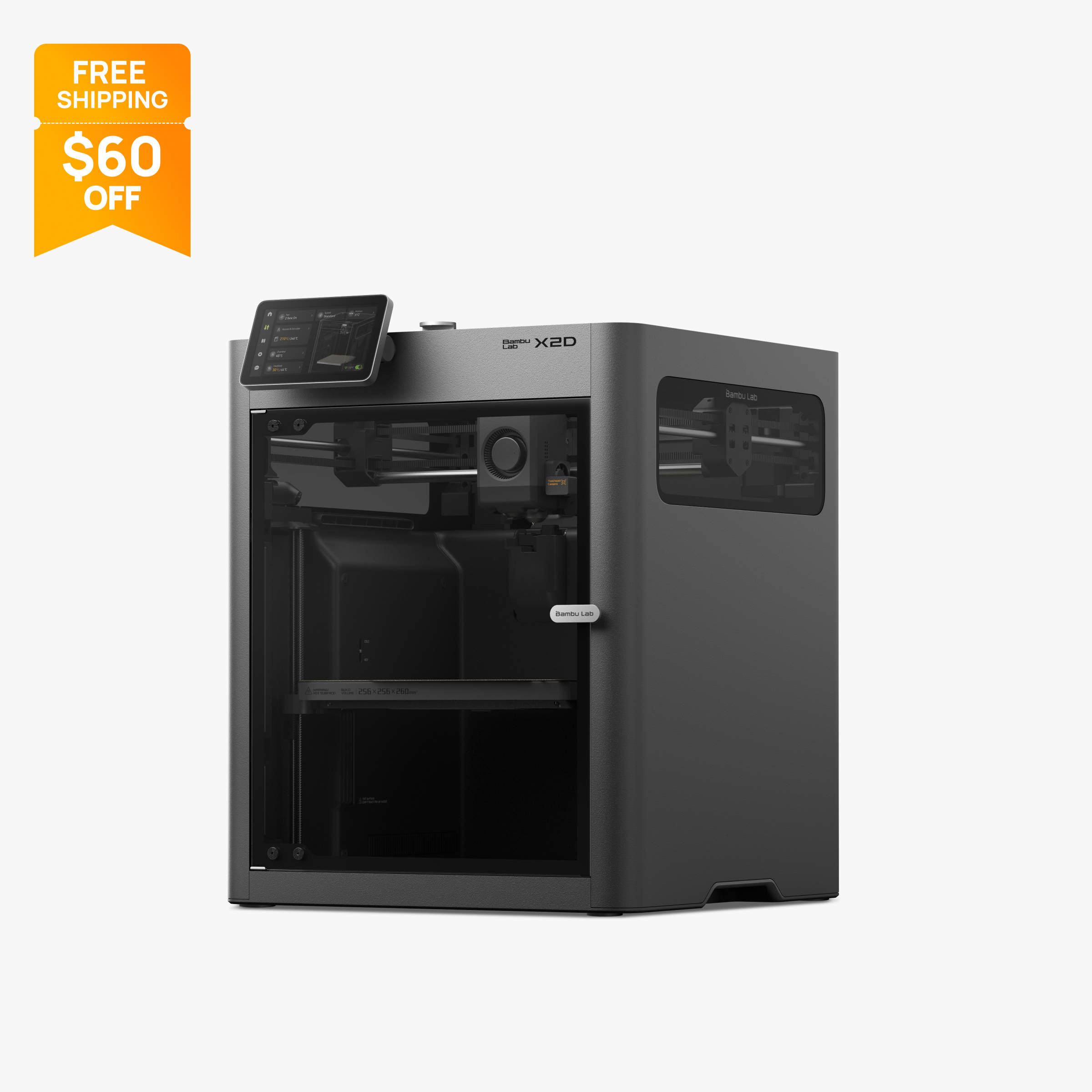
X2D vs X1C: the X1 Carbon reached end of life in March 2026 and is no longer sold new. X1C owners get a second nozzle, 65 °C chamber heating, 1000 mm/s and HEPA filtration by moving to the X2D. Keep a working X1C if you print one material at a time and Bambu's support dates suit you.
Specs side by side
| Spec | Bambu Lab X2D | Bambu Lab X1 Carbon |
|---|---|---|
| Type | FDM | FDM |
| Price | $589 | Check current price |
| Build volume | 256×256×260 mm | 256×256×256 mm |
| Max speed | 1000 mm/s | 500 mm/s |
| Multicolor | Yes (Dual nozzle; AMS 2 Pro / AMS HT optional (one AMS 2 Pro in the AMS Combo); up to 25 colors per Bambu) | Yes (AMS (optional)) |
| Enclosed | Yes | Yes |
| Auto bed leveling | Yes | Yes |
| Connectivity | Dual-band Wi-Fi, USB | Wi-Fi, Bambu-Bus, microSD |
| Noise | Not listed | Not listed |
| Release year | Not listed | 2022 |
Quick answer
The Bambu Lab X1 Carbon is no longer sold new: Bambu announced end of life for the X1 series on March 31, 2026, and its old US store page now redirects to the printer collection. This X2D vs X1C page is for X1 Carbon owners deciding whether to upgrade, people weighing a used X1C, and readers of older reviews. The Bambu Lab X2D adds a second nozzle, active chamber heating to 65 °C, a 1000 mm/s top speed (versus 500 mm/s), H12 HEPA filtration and a toolhead camera, while keeping a hardened steel 300 °C hot end and a 5-inch touchscreen. If you are buying new today, the choice is the X2D or another current model, not an X1C. If your X1 Carbon still works well, there is no rush.
Key differences
Availability and support
Bambu ended manufacturing and active sales of the X1, X1 Carbon and X1E on March 31, 2026. Its published timeline: firmware bug fixes and feature updates until May 31, 2027, security patches until May 31, 2029, and spare parts and support until March 31, 2031. Bambu warns some parts may sell out before 2031.
The X2D is a current product. On October 30, 2026 it was listed and in stock on Bambu's US store, and its FAQ calls it "X1C's next chapter." For owners, the practical question is timing: an X1C keeps printing after feature updates end, but new Bambu Studio features may increasingly target current machines. For used buyers, those dates are a reason to price a used X1C well below a new X2D.
Second nozzle
The X2D's headline addition is an auxiliary nozzle. Bambu says it can print support in its own material for cleaner removal, combine PLA and TPU in one part, and cut purge waste on color changes. The X1 Carbon has one nozzle and changes material only through the AMS, purging each time.
The two X2D nozzles are not equal. The main extruder uses a PMSM servo motor and the auxiliary one a stepper; Bambu says auxiliary print quality is slightly lower and recommends official filament on it. With the auxiliary nozzle or both nozzles, usable width drops to 235.5 mm. If you print single-material parts most of the time, the second nozzle is a nice option rather than a reason to upgrade on its own.
Chamber heating and filtration
The X1 Carbon is enclosed but has no active chamber heater. The X2D heats its chamber to 65 °C, which helps large ABS, ASA, nylon and PC parts resist warping and layer splitting as they cool. For X1C owners who fight warping on big engineering parts, this is likely the most useful upgrade.
The X2D also lists three-stage filtration: a G3 pre-filter, an H12 HEPA filter and coconut shell activated carbon, targeting particles and odors. Bambu says the X2D is UL 2904 certified for indoor air quality with its PLA Basic and PETG Basic, and rates it below 50 dB under typical conditions. Bambu does not list a noise figure for the X1 Carbon in the spec sheet we checked.
Speed, bed and build volume
Bambu lists the X2D at 1000 mm/s and the X1 Carbon at 500 mm/s, with the same 20,000 mm/s² acceleration. Matching acceleration means everyday small parts will not finish twice as fast; the gain shows most on long moves and large infill. The X2D also offers an optional high flow hot end rated at 65 mm³/s, against 40 mm³/s for its standard hot end.
The X2D bed reaches 120 °C. The X1 Carbon spec sheet lists 120 °C on 110 V power (US units) and 110 °C on 220 V, so US owners see no bed temperature gain.
Build volume is 256 x 256 x 256 mm on the X1 Carbon and 256 x 256 x 260 mm on the X2D's main nozzle, a 4 mm height gain. If you need much more room, the H2D is the larger Bambu (see below).
Hot end and materials
Both use hardened steel nozzles and gears with a 300 °C limit, so both handle carbon and glass fiber filaments without upgrades. The X1 Carbon spec sheet rates PA, PC and fiber-reinforced polymers as ideal. The X2D lists fiber-reinforced PLA, PETG, ABS, ASA, PA6, PAHT, PPA and PET on the main hot end, with some grades marked print with caution on the auxiliary hot end. The X2D's main extruder adds a PMSM servo motor, which Bambu lists among the main additions over the X1C.
Sensors, screen and connectivity
Both have a 5-inch 1280 x 720 touchscreen. The X1 Carbon has Bambu's micro lidar and a 1080p chamber camera. Both list a door sensor, a run-out sensor and power loss recovery. The X2D adds a 1600 x 1200 toolhead camera (Bambu names it among the X2D additions) and also lists a 1920 x 1080 live view camera and a filament tangle sensor.
Connectivity changes: the X1 Carbon lists Wi-Fi, Bambu-Bus and microSD; the X2D lists dual-band Wi-Fi, 8 GB of built-in storage and a USB port. The X2D spec sheet says Ethernet is not available.
Build plates and everyday use
Bambu lists the X2D as supporting the Textured PEI Plate, Smooth PEI Plate, Cool Plate SuperTack and Engineering Plate, and it has a built-in filament cutter. Day to day, the workflow will feel familiar to an X1C owner: the same Bambu Studio slicer, control from Bambu's mobile and PC apps, and a 5-inch touchscreen. Bambu's X2D spec page lists macOS, Windows and Linux for its software, and third-party slicers that export standard G-code are supported with some advanced features missing, the same caveat Bambu gives for its other printers.
Multicolor
The X1 Carbon supports Bambu's AMS. Bambu says the X2D supports up to 25-color printing with its dual-nozzle system and AMS units, and that more than two AMS units need a 4-in-1 PTFE adapter. The X2D lists the AMS 2 Pro and AMS HT as optional; check Bambu's compatibility notes before moving an older AMS from an X1C.
Upgrade now or wait?
For a working X1 Carbon, there is no hard deadline today. Feature updates continue to May 31, 2027, so an owner can keep printing and decide later. The case for upgrading sooner is strongest if you already hit the X1C's limits: warping on large ABS or nylon parts (addressed by the heated chamber), heavy purge waste on multi-material jobs (reduced by the second nozzle), or a printer in a living space where HEPA filtration matters. The case for waiting is strongest if your X1C mostly prints PLA, PETG and fiber blends in one material per job, since the X2D's hot end limit and build volume are nearly the same.
Selling a used X1C can offset part of the X2D cost, but resale values depend on condition and the support timeline, and we do not track used prices.
Price and what you get
The X1 Carbon has no official current price: Bambu no longer sells it, and its US store URL redirects to the printer collection. Any X1C on offer now is used or third-party leftover stock.
The X2D prices below were checked on Bambu's US store on October 30, 2026, during a Black Friday sale. Prices change often, so check the store before buying.
- Bambu Lab X2D, printer only: $589 on sale, typical $649.
- X2D AMS Combo with one AMS 2 Pro: $789 on sale, typical $899.
- X2D Print More Bundle with two AMS 2 Pro: $1,049. X2D Combo Print with Care Bundle: $836.
When judging a used X1C, compare its asking price with the X2D's current price and weigh the May 2027 end of feature updates. A used unit priced close to a new X2D gives up the second nozzle, heated chamber and years of support for little saving. The X2D sits within our best under $1,000 range.
Who should buy which
Upgrade to the X2D, or buy it new, if:
- You want dual-nozzle printing for support materials or mixed rigid and flexible parts.
- You print large ABS, ASA, nylon or PC parts and want 65 °C active chamber heating.
- You want HEPA filtration for a printer in a shared indoor space.
- You want a machine with Bambu's ongoing feature updates.
Keep an X1 Carbon, or consider a used one, if:
- Your current X1C prints single-material jobs reliably and you have no warping trouble.
- Bambu's 2027, 2029 and 2031 support dates fit how long you plan to keep it.
- A used unit is priced well below a new X2D and you accept the end-of-life timeline.
Also consider
- Bambu Lab P2S: a current single-nozzle printer with a hardened steel nozzle, 5-inch touchscreen and 600 mm/s, $449 on sale (typical $549). It lacks chamber heating, like the X1C. See P2S vs X2D.
- Bambu Lab H2D: dual nozzles and a 65 °C chamber with a 325 x 320 x 325 mm single-nozzle volume and 350 °C nozzles, from $1,399 on sale. See X2D vs H2D.
- QIDI Q2: 65 °C active chamber heating, a 370 °C nozzle and a 270 x 270 x 256 mm volume for $499 at the time of writing.
If you are comparing older Bambu machines, our P1S vs X1 Carbon page covers that pair, and the best enclosed 3D printers page lists current options.
Frequently asked questions
Is the X2D the successor to the X1 Carbon?
In practice, yes. Bambu's end-of-life post does not name a successor, but the X2D store FAQ says "X2D is X1C's next chapter," pointing to its dual nozzles, heated chamber and servo extruder as the main additions.
Should I upgrade from an X1 Carbon to an X2D?
Upgrade if you want a second nozzle for support or mixed materials, active chamber heating for large ABS or nylon parts, or longer feature support. If your X1 Carbon prints single-material jobs well, Bambu's support timeline lets you keep using it for years.
How long will Bambu support the X1 Carbon?
Bambu's published timeline is firmware bug fixes and feature updates until May 31, 2027, security patches until May 31, 2029, and spare parts and support until March 31, 2031. Bambu notes some spare parts may sell out earlier.
Is the X2D faster than the X1 Carbon?
On paper. Bambu lists 1000 mm/s top speed for the X2D and 500 mm/s for the X1 Carbon, with the same 20,000 mm/s² acceleration. Gains are largest on long, straight moves.
Does the X1 Carbon have a heated chamber?
No. The X1 Carbon is enclosed but has no active chamber heater. The X2D heats its chamber to 65 °C, according to Bambu's spec sheet.
Will my AMS work with the X2D?
Bambu lists the AMS 2 Pro and AMS HT as optional for the X2D and says more than two AMS units need a 4-in-1 PTFE adapter. Check Bambu's compatibility notes for older AMS units before moving one over.
Sources
- The X1 series is EOL (official Bambu Lab blog)
- X1 series EOL announcement and support timeline (official Bambu Lab forum)
- Bambu Lab X1 Carbon technical specifications PDF (official)
- Bambu Lab X2D technical specifications (official)
- Bambu Lab X2D on the official US store (price, bundles, FAQ)
- Bambu Lab US store 3D printer collection (lineup and prices)
- Bambu Lab P2S technical specifications (official)
- Bambu Lab P2S on the official US store (price, combo contents, FAQ)
- Bambu Lab H2D on the official US store (prices by configuration)
- QIDI Q2 on QIDI's US store