Bambu Lab X2D vs Bambu Lab H2D
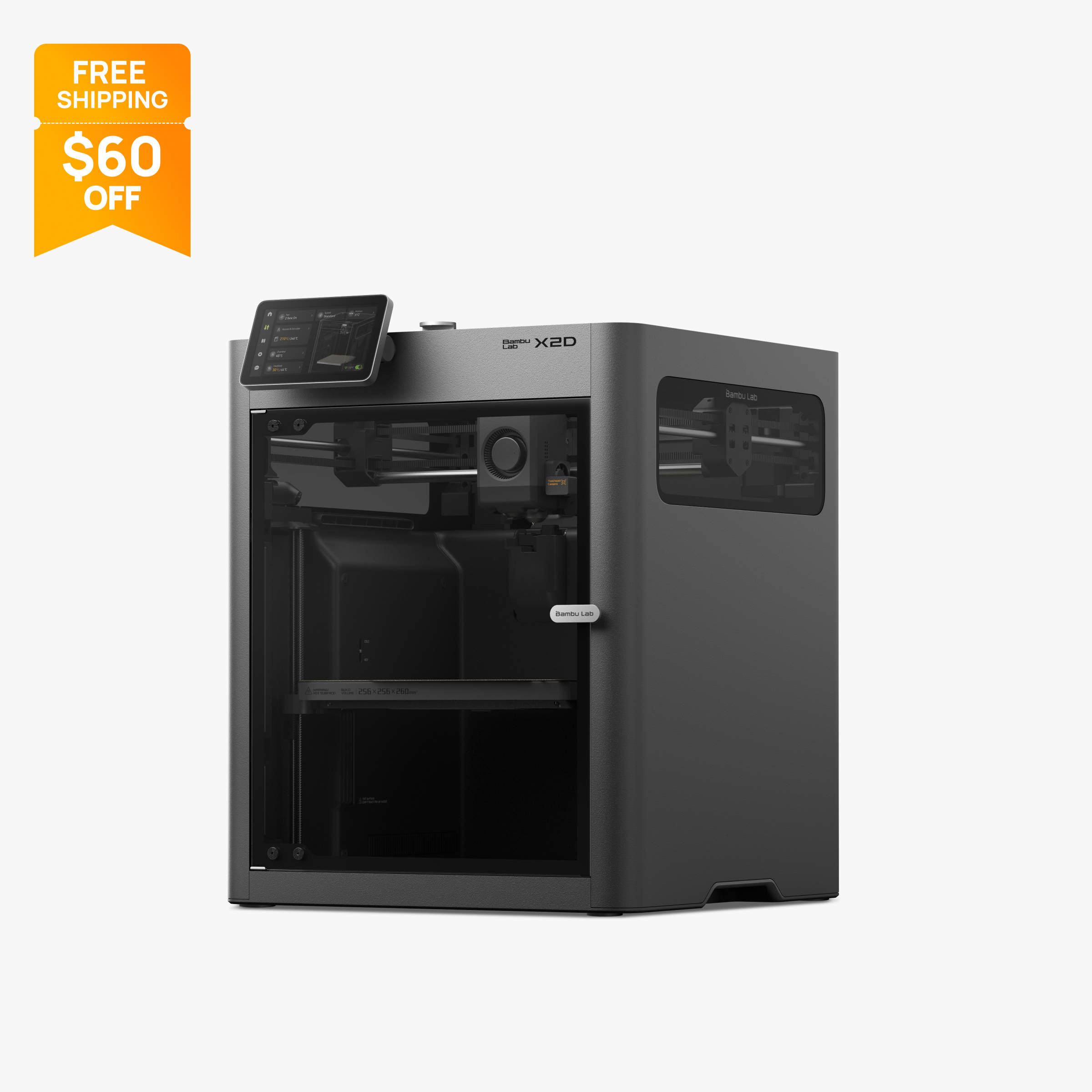
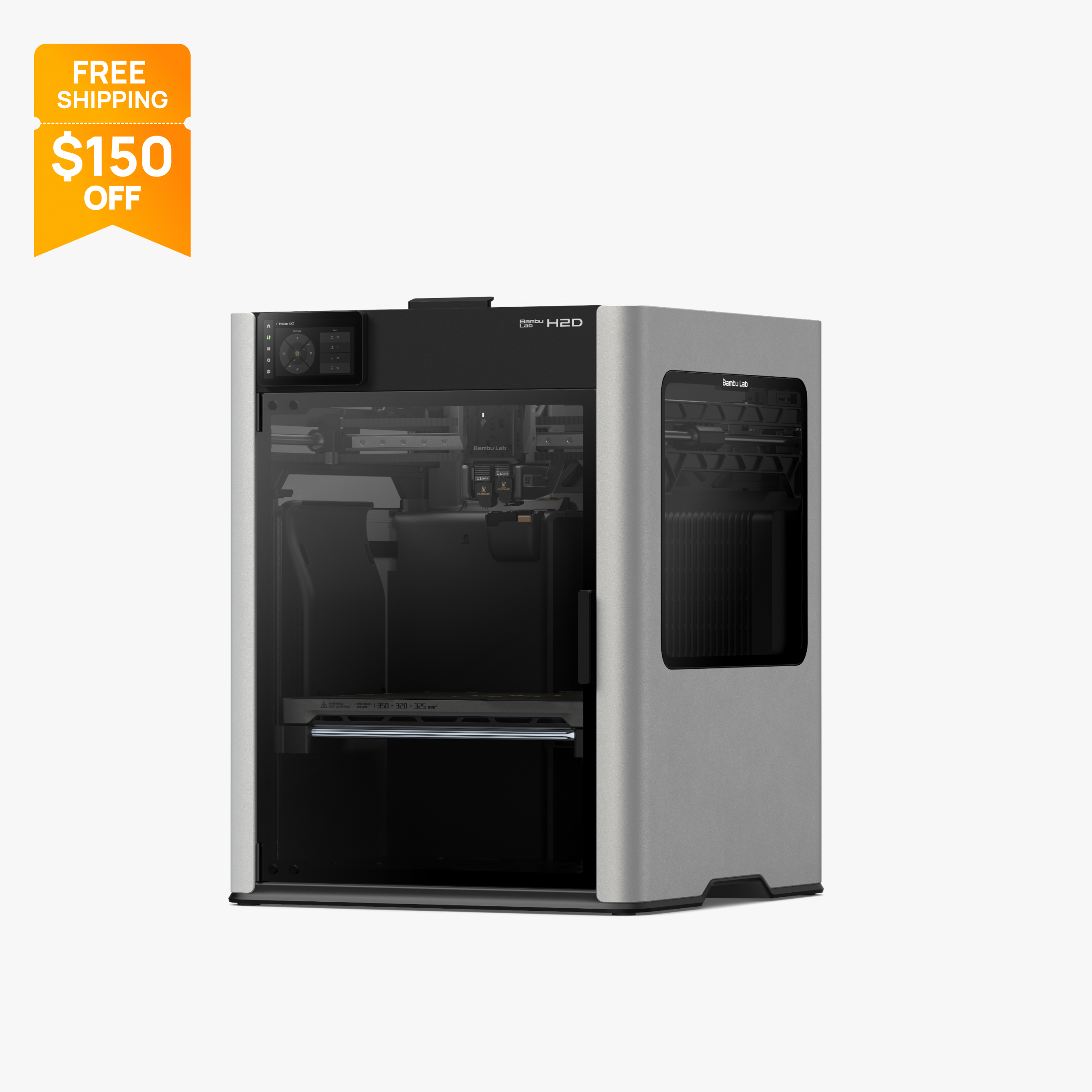
Verdict
In the X2D vs H2D choice, both are dual-nozzle Bambu printers with 65 °C heated chambers. Pick the X2D if your parts fit in about 256 mm and you want a smaller, much cheaper machine. Pick the H2D if you need its 325 x 320 x 325 mm volume, 350 °C nozzles for PPS and similar polymers, or the laser modules.
Specs side by side
| Spec | Bambu Lab X2D | Bambu Lab H2D |
|---|---|---|
| Type | FDM | FDM |
| Price | $589 | $1,399 |
| Build volume | 256×256×260 mm | 325×320×325 mm |
| Max speed | 1000 mm/s | 1000 mm/s |
| Multicolor | Yes (Dual nozzle; AMS 2 Pro / AMS HT optional (one AMS 2 Pro in the AMS Combo); up to 25 colors per Bambu) | Yes (Dual nozzle; AMS 2 Pro / AMS HT optional (AMS 2 Pro included only in the AMS Combo)) |
| Enclosed | Yes | Yes |
| Auto bed leveling | Yes | Yes |
| Connectivity | Dual-band Wi-Fi, USB | Dual-band Wi-Fi, USB |
| Noise | Not listed | Not listed |
| Release year | Not listed | 2025 |
Quick answer
X2D vs H2D is a choice between two dual-nozzle Bambu printers that share a 65 °C actively heated chamber, a 1000 mm/s top speed, 20,000 mm/s² acceleration, a 120 °C bed and HEPA filtration. At the time of writing (October 2026), the Bambu Lab X2D is $589 on a Black Friday sale (typical $649) and the base Bambu Lab H2D is $1,399 on sale (typical $1,549), both without an AMS. Pick the X2D if your parts fit in about 256 mm and you print materials up to PA and PC. Pick the H2D if you need a 325 x 320 x 325 mm single-nozzle volume, 350 °C nozzles for PPS and similar polymers, or the optional laser and cutting modules.
Key differences
Build volume
This is the clearest split. Bambu lists the X2D at 256 x 256 x 260 mm with its main nozzle, and 235.5 x 256 x 256 mm when the auxiliary nozzle or both nozzles print. The H2D lists 325 x 320 x 325 mm with a single nozzle, 300 x 320 x 320 mm when both nozzles print, and 350 x 320 x 320 mm as the total area the two nozzles can reach.
In practice, the H2D gains roughly 64 to 70 mm in each direction for single-nozzle work, and its dual-nozzle area is larger than the X2D's single-nozzle area. That matters for helmets, large enclosures, full-size cosplay parts and batches of production parts on one plate. If most of your prints fit comfortably on a 256 mm plate, the extra volume costs a lot of money and bench space for little benefit. Our best large-format printers page covers other big options.
Nozzle temperature and materials
Both printers use hardened steel nozzles, but the H2D reaches 350 °C and the X2D 300 °C. Bambu's H2D material list adds PPS and PPS-CF/GF, plus PPA-CF/GF, on top of the usual PLA, PETG, ABS, ASA, PC, PA, PET and TPU. The X2D's main hot end handles PLA, PETG, ABS, ASA, TPU, PET, PA, PC and PVA, plus carbon and glass fiber reinforced PLA, PETG, ABS, ASA, PA6, PAHT, PPA and PET.
For most engineering parts, 300 °C plus a 65 °C chamber covers ABS, ASA, nylon and polycarbonate. The H2D's 350 °C limit matters if you specifically need high-temperature polymers like PPS for heat or chemical resistance. Both offer an optional 65 mm³/s high flow hot end over the standard 40 mm³/s.
How the two nozzles work
Both machines print two materials per job with less purge waste than a single-nozzle printer swapping filament through an AMS. Bambu's store suggests uses such as support in a separate material, or PLA and TPU in one part.
On the X2D, Bambu is open that the nozzles differ: the main extruder uses a PMSM servo motor, the auxiliary one a stepper motor, auxiliary print quality is slightly lower, official filament is recommended on it, and flow dynamics calibration applies to the main nozzle only. Some materials, such as PETG-CF and PA6-CF, are marked print with caution on the auxiliary hot end. Bambu's H2D data we checked does not describe a comparable quality difference, so we do not claim one either way. On both, plan dual-nozzle jobs around the smaller dual-nozzle area.
Size, weight and power
Bambu lists the X2D at 392 x 406 x 478 mm and 16.25 kg. The H2D is 492 x 514 x 626 mm and 31 kg, close to twice the weight, and needs a large, sturdy bench. On 110 V power, Bambu lists maximum draw at 1100 W for the X2D and 1320 W for the H2D, with peak power held briefly while the bed heats. Avoid sharing a circuit with other high-draw tools during warm-up on either, and especially on the H2D.
For a desk in a home office or spare room, the X2D is much easier to place. For a workshop or small business bench, the H2D's size is less of a concern.
What the two share
It helps to list what does not change, because it narrows the decision. Bambu lists both printers at 1000 mm/s top speed and 20,000 mm/s² acceleration, so on parts that fit both machines, motion specs give neither an edge. Both heat the bed to 120 °C and the chamber to 65 °C, so the X2D handles ABS, ASA, nylon and PC in the same thermal conditions as the H2D, just on a smaller plate. Both use hardened steel nozzles and gears, both have a filament run-out sensor and power loss recovery, and both use standard 1.75 mm filament.
That means the decision is not about speed tier or chamber temperature. It rests on three questions: do your parts need more than about 256 mm, do your materials need more than 300 °C, and do you want a laser in the same frame? If all three answers are no, the H2D's extra cost buys capacity you will not use.
Laser and cutting modules
Only the H2D offers these. Bambu sells 10 W and 40 W laser modules and a cutting module for engraving, cutting and plotting; the Laser Full Combos are listed at $1,949 (10 W) and $2,399 (40 W) at the time of writing (October 2026). Bambu rates the laser modules Class 4 on their own and Class 1 only when the printer's protections are complete and working, so ventilation and Bambu's safety guidance are required. If you were going to buy a separate laser engraver, the H2D can replace it; if not, this feature adds nothing for you.
Cameras, filtration and software
Both list three-stage filtration with a G3 pre-filter, H12 HEPA filter and activated carbon. The X2D has a 1080p live view camera and a 1600 x 1200 toolhead camera; the H2D lists live view, nozzle and toolhead cameras at 1080p. Both have door, run-out and tangle sensors, power loss recovery, 5-inch 1280 x 720 touchscreens, 8 GB of built-in storage with USB, and dual-band Wi-Fi.
Bambu rates the X2D below 50 dB under typical conditions; the H2D data we checked lists no comparable figure. Both accept third-party slicers that export standard G-code, with some advanced features missing.
Multicolor and AMS
Neither base model includes an AMS. Bambu says the X2D supports up to 25-color printing with AMS units, and connecting more than two AMS units needs a 4-in-1 PTFE adapter. The H2D supports the AMS 2 Pro and AMS HT; its AMS Combo includes one AMS 2 Pro. See best multicolor printers for more.
Price and what you get
Prices were checked on Bambu's US store on October 28, 2026 (H2D) and October 30, 2026 (X2D). The X2D prices were Black Friday sale prices, and prices change often, so check the store before buying.
- Bambu Lab X2D, printer only: $589 on sale, typical $649.
- X2D AMS Combo with one AMS 2 Pro: $789 on sale, typical $899. X2D Print More Bundle with two AMS 2 Pro: $1,049.
- Bambu Lab H2D standard, no AMS: $1,399 on sale, typical $1,549.
- H2D AMS Combo: $1,599 on sale, typical $1,749. Laser Full Combos: $1,949 (10 W) and $2,399 (40 W).
At sale prices, the base H2D costs more than twice the printer-only X2D. The money goes to build volume, 350 °C nozzles and the option of laser work. If none of those three apply to you, the X2D delivers the same chamber temperature, top speed, bed temperature and filtration for far less. The X2D sits within our best under $1,000 range; the H2D is a small business class machine.
Who should buy which
Buy the X2D if:
- Your parts fit in about 256 x 256 mm, or 235.5 mm wide for dual-nozzle jobs.
- You print ABS, ASA, nylon, PC and fiber blends, and 300 °C is enough.
- Desk space, weight or a shared household circuit is a concern.
- You want the most capable dual-nozzle Bambu for the least money.
Buy the H2D if:
- You regularly print parts larger than 256 mm, or want bigger plates for batches.
- You need 350 °C for PPS or similar high-temperature filaments.
- You want laser engraving, cutting or plotting in the same machine.
- You run a small business or prototyping shop with a sturdy bench and room to spare.
Also consider
- Creality K2 Plus: a 350 x 350 x 350 mm enclosed printer with a 60 °C heated chamber and 350 °C nozzle, $999 on sale without a CFS at the time of writing. See H2D vs K2 Plus.
- QIDI Plus5: 320 x 320 x 300 mm, a 370 °C nozzle and 65 °C active chamber heating for $749 on QIDI's US store at the time of writing.
- Bambu Lab P2S: a single-nozzle 256 mm printer without chamber heating for $449 on sale, if dual nozzles are not essential. See P2S vs X2D.
For more, see our best enclosed 3D printers and the how a 3D printer works guide.
Frequently asked questions
What is the difference between the X2D and the H2D?
Both are enclosed dual-nozzle printers with 65 °C active chamber heating, 1000 mm/s top speed and a 120 °C bed. The H2D is larger, with a 325 x 320 x 325 mm single-nozzle volume versus 256 x 256 x 260 mm, reaches 350 °C instead of 300 °C, and supports optional laser and cutting modules.
Is the H2D worth the extra cost over the X2D?
Only if you need the larger build volume, 350 °C nozzles or the laser modules. At the time of writing (October 2026) the base H2D was $1,399 on sale and the printer-only X2D $589 on Bambu's US store. If your parts fit in roughly 256 mm and you print up to PA and PC, the X2D covers that.
Can the X2D print PPS?
Bambu does not list PPS among the X2D's supported filaments, while the H2D's list includes PPS and PPS-CF/GF, supported by its 350 °C hot ends. The X2D tops out at 300 °C.
Does the H2D come with an AMS?
Not the base model. The H2D standard ships without an AMS; the H2D AMS Combo adds an AMS 2 Pro. The X2D is also sold as printer only or as an AMS Combo with one AMS 2 Pro.
Are both nozzles the same on the X2D and H2D?
On the X2D, no: Bambu says the auxiliary nozzle uses a stepper motor, gives slightly lower print quality than the main servo-driven nozzle, and narrows the print width to 235.5 mm. On the H2D, dual-nozzle printing reduces the usable volume to 300 x 320 x 320 mm.
Does the X2D or H2D have a laser?
Only the H2D. Bambu offers 10 W and 40 W laser modules and a cutting module for it, sold as Laser Full Combos or an upgrade kit. The X2D is a 3D printer only.
Sources
- Bambu Lab X2D technical specifications (official)
- Bambu Lab X2D on the official US store (price, bundles, FAQ)
- Bambu Lab H2D technical specifications (official)
- Bambu Lab H2D on the official US store (prices by configuration)
- Bambu Lab US store 3D printer collection (lineup and prices)
- Bambu Lab P2S technical specifications (official)
- Bambu Lab P2S on the official US store (price, combo contents, FAQ)
- Creality K2 Plus on Creality's store
- QIDI Plus5 on QIDI's US store