Bambu Lab
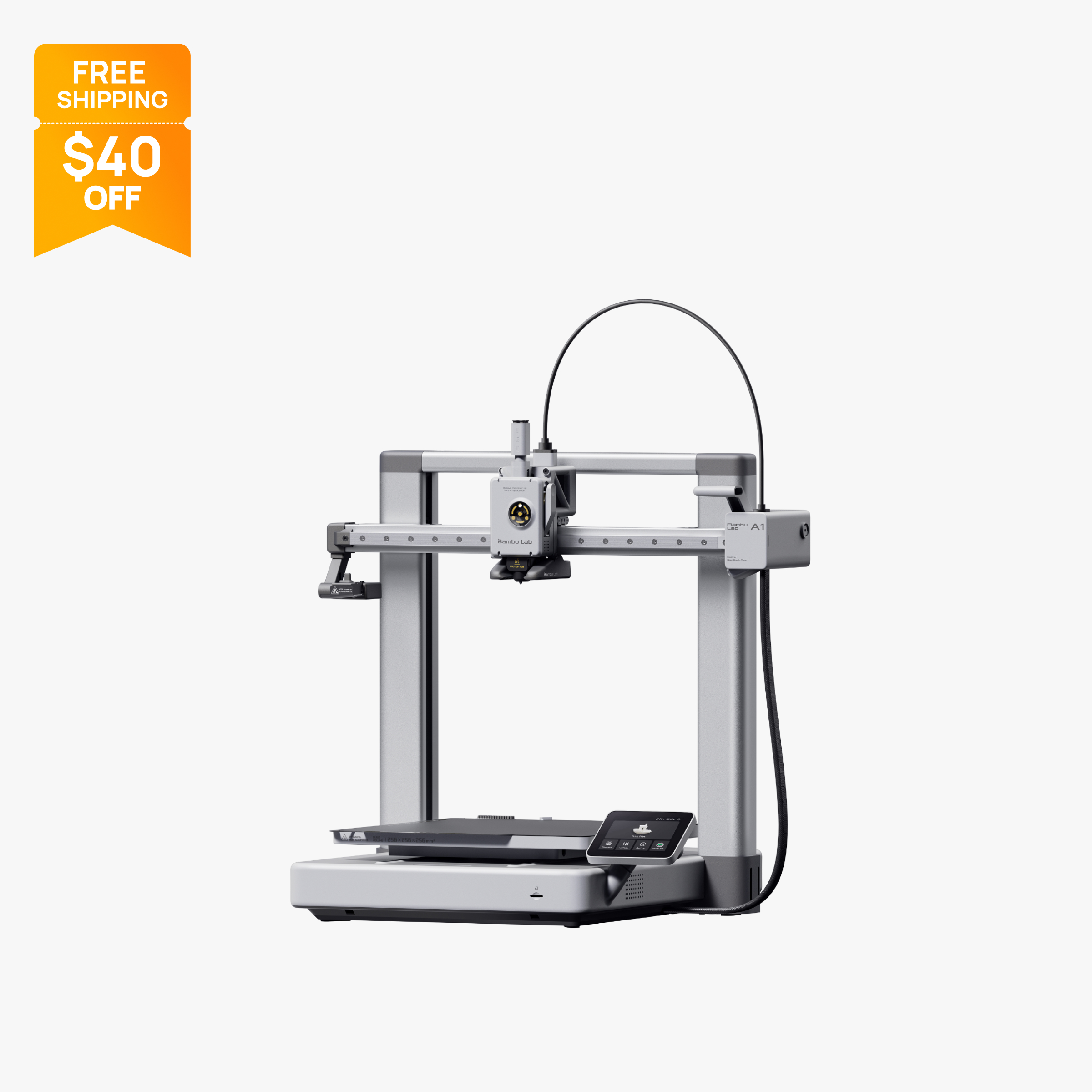
Bambu Lab A1
Open-frame 256 mm bed slinger with full auto calibration and optional 4-color AMS Lite.
$259Price checked October 28, 2026
Best for First 3D printer with a full-size bedBest for PLA, PETG and TPU projectsBest for Quiet home or classroom printingBest for Trying multi-color later with AMS Lite
Overview
The Bambu Lab A1 is an open-frame bed slinger with a 256 x 256 x 256 mm build volume, a 300 °C all-metal hot end and a 100 °C bed. It calibrates itself before every print and can add the AMS Lite for up to 4-color printing.
What it is
The Bambu Lab A1 is a full-size, open-frame 3D printer that uses a moving bed (often called a bed slinger) rather than the CoreXY layout of Bambu's enclosed P and X series. This listing covers the printer on its own. The same machine is sold as the A1 Combo with the AMS Lite filament changer included. Bambu positions the A1 as an entry point that still offers a large 256 x 256 x 256 mm build volume, and its store page describes it as fully auto calibrated, with no manual tuning needed.
Key specs that matter
- Build volume: 256 x 256 x 256 mm, large enough for a full-size helmet in one piece according to Bambu.
- Motion: up to 500 mm/s toolhead speed and 10,000 mm/s² acceleration.
- Hot end: all-metal, up to 300 °C, with a stainless steel 0.4 mm nozzle. 0.2, 0.6 and 0.8 mm nozzles are optional.
- Bed: up to 100 °C, with textured PEI included and several other Bambu plates supported.
- Calibration: Bambu says the A1 calibrates Z-offset, bed level, vibration resonance and nozzle pressure for every job.
- Sensors: filament run-out, tangle detection, filament odometry, power loss recovery and a low-frame-rate camera (up to 1080p) for timelapse.
- Connectivity: Wi-Fi, Bambu-Bus and microSD, with a 3.5-inch touchscreen. Bambu also offers a LAN-only mode.
- Noise: the US store lists operation as low as 49 dB, helped by active motor noise canceling.
Who it suits
The A1 fits buyers who mainly print PLA, PETG and TPU and want a large bed without paying for an enclosure. It suits beginners who would rather print than tune, families and classrooms that value low noise, and hobbyists who want to try multi-color printing later by adding the AMS Lite. Because it works with Bambu Studio and with third-party slicers that export standard G-code, it also fits people who already have a slicer workflow.
What to know before buying
Bambu lists ABS, ASA, PC, PA, PET and fiber-filled filaments as not recommended. Its FAQ says hot materials can work for small, low-infill parts, but the open frame raises the risk of warping and weak layers, and Bambu does not recommend enclosing the A1. Abrasive filaments such as carbon fiber or glow-in-the-dark blends also need a hardened steel nozzle swap.
Multi-color printing is limited to one AMS Lite, so the ceiling is 4 filaments per print. The full AMS, AMS 2 Pro and AMS HT can connect only through the separate AMS HUB accessory. If you already know you want multi-color printing, the A1 Combo bundle costs less than buying the AMS Lite later: on 2026-10-28 the A1 was $259, the Combo $359 and the AMS Lite alone $159 on the US store.
Bambu's own store FAQ notes a January 2024 recall related to the heatbed cable. It states that units sold after January 30, 2024 are not from the affected batch, and the current listing describes a reinforced heatbed cable. A bed slinger also needs more desk depth than its footprint suggests, since the bed moves front to back during printing; Bambu lists the printer at 465 x 410 x 430 mm.
Specifications
| Type | FDM |
|---|---|
| Price | $259 |
| Build volume | 256×256×256 mm |
| Max speed | 500 mm/s |
| Multicolor | Yes (AMS Lite (optional, one unit, up to 4 colors)) |
| Enclosed | No |
| Auto bed leveling | Yes |
| Connectivity | Wi-Fi, Bambu-Bus, microSD |
| Noise | 49 dB |
| Release year | 2023 |
Pros and cons
Pros
- The 256 x 256 x 256 mm build volume matches Bambu's enclosed P1S, which is large for an entry-level printer.
- Bambu says it calibrates Z-offset, bed level, vibration and nozzle pressure automatically before every print, so setup needs no manual tuning.
- The US store lists noise as low as 49 dB, helped by active motor noise canceling, which suits shared rooms.
- Adding the optional AMS Lite enables up to 4-color printing without changing printers.
- A full sensor set is included: run-out, tangle detection, filament odometry, power loss recovery and a timelapse camera.
- It works with Bambu Studio and with third-party slicers that export standard G-code, and offers a LAN-only mode.
Cons
- The open frame means Bambu lists ABS, ASA, PC and PA as not recommended, and it advises against enclosing the printer.
- Only one AMS Lite is supported, so multi-color printing tops out at 4 filaments per job.
- The stock stainless steel nozzle must be swapped for hardened steel before printing carbon fiber or other abrasive filaments.
- As a bed slinger, the moving bed needs extra clearance front to back beyond the 465 x 410 x 430 mm frame.
- The 100 °C bed limit and lack of chamber heating rule out most engineering materials for larger parts.
- Connecting a full AMS, AMS 2 Pro or AMS HT requires buying the separate AMS HUB accessory.
Frequently asked questions
Can the Bambu Lab A1 print ABS or ASA?
Bambu lists ABS, ASA, PC and PA as not recommended on the A1. Its FAQ says these filaments can work for small, low-infill parts, but the open frame raises the risk of warping and weak layer bonding on larger prints. If ABS or ASA is a priority, an enclosed model such as the P1S is a better match.
How many colors can the A1 print?
With the AMS Lite, the A1 can print with up to 4 filaments in one job. Bambu's FAQ states the A1 supports only one AMS Lite unit, so it cannot be expanded to 16 colors the way the P1S can with stacked AMS units.
Does the A1 work with third-party filament and slicers?
Yes. Bambu's spec sheet says the A1 works with Bambu Studio and with third-party slicers that export standard G-code, such as PrusaSlicer, SuperSlicer and Cura, though some advanced features may not be supported. Any 1.75 mm filament in the supported material list can be used.
Can I enclose the A1 to print hotter materials?
Bambu says it does not recommend enclosing the A1. The machine is designed as an open bed slinger, so buyers who want stable chamber temperatures should look at an enclosed printer instead of adding a box.
Was the A1 recalled?
Yes. Bambu's US store FAQ refers to a January 2024 recall tied to a heatbed cable issue. It states that A1 printers sold after January 30, 2024 are not from the recalled batch and include the fixes, and the current store listing mentions an upgraded, Kevlar-reinforced heatbed cable.
Sources
Verdict
Buy the A1 if you want a large, self-calibrating printer for PLA, PETG and TPU and like the option to add 4-color printing later. Look elsewhere, such as an enclosed P1S or P2S, if you plan to print ABS, ASA or fiber-filled materials regularly.
Comparisons
Featured in
Related printers