Bambu Lab H2D vs Creality K2 Plus

Verdict
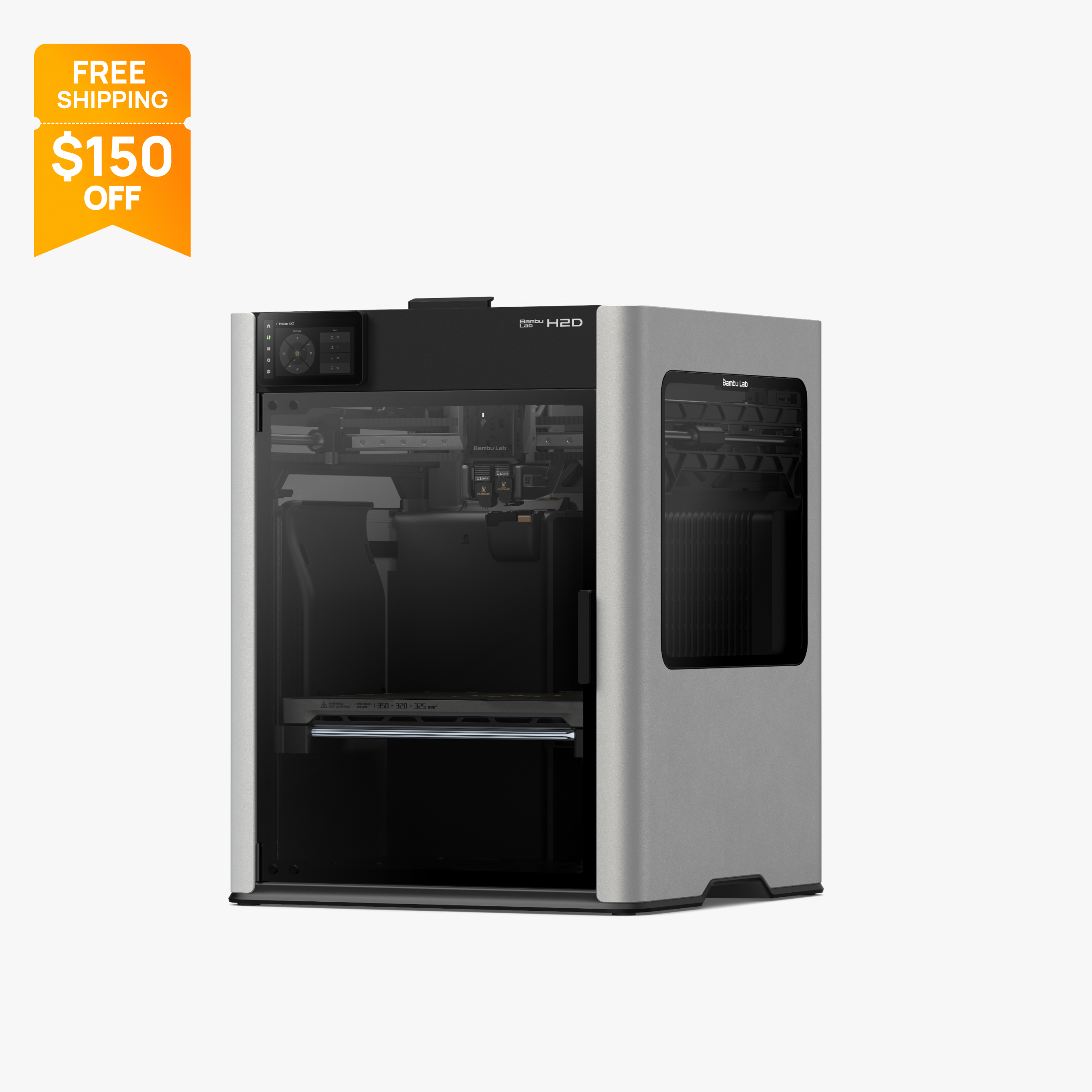
Choose the H2D for two-nozzle multicolor, a 65°C chamber and an optional laser; choose the K2 Plus for a bigger 350 mm cube and a lower price. Compare like for like: H2D AMS Combo $1,599 against K2 Plus Combo $1,199 (October 2026).
Specs side by side
| Spec | Bambu Lab H2D | Creality K2 Plus |
|---|---|---|
| Type | FDM | FDM |
| Price | $1,399 | $999 |
| Build volume | 325×320×325 mm | 350×350×350 mm |
| Max speed | 1000 mm/s | 600 mm/s |
| Multicolor | Yes (Dual nozzle; AMS 2 Pro / AMS HT optional (AMS 2 Pro included only in the AMS Combo)) | Yes (CFS (optional; Combo includes 1 CFS for 4 colors, up to 4 CFS for 16 colors)) |
| Enclosed | Yes | Yes |
| Auto bed leveling | Yes | Yes |
| Connectivity | Dual-band Wi-Fi, USB | Wi-Fi (2.4 and 5 GHz), Ethernet, USB drive, Creality Cloud |
| Noise | Not listed | Not listed |
| Release year | 2025 | 2024 |
Quick answer
Both are large, enclosed, actively heated multicolor printers, but they take different routes. The Bambu Lab H2D uses two nozzles and a 1000 mm/s toolhead, and can add a laser module. The Creality K2 Plus uses one nozzle with an optional multi-spool CFS and a bigger 350 x 350 x 350 mm cube.
Pick the H2D if you want two-material printing with less purge waste, a hotter 65°C chamber and the option of laser engraving. Pick the K2 Plus if you want the larger single-nozzle volume and a lower price. Compare like for like: the H2D base ships without an AMS and the K2 Plus base ships without a CFS, so match the H2D AMS Combo against the K2 Plus Combo.
Key differences
Toolhead and multicolor approach
The H2D has two nozzles, so it can hold two materials or colors on the toolhead at once. In principle that means fewer filament swaps through a single nozzle, and so less purge on two-material jobs. For more than two filaments you add an AMS 2 Pro or AMS HT, which the base H2D does not include. Check Bambu's page for how many units and colors your configuration supports.
The K2 Plus uses one nozzle and relies on Creality's CFS. One CFS holds four colors, and Creality supports up to four CFS units for 16 colors. Single-nozzle changes purge filament each time. For a model with 206 color swaps, Tom's Hardware reports 121.7 g of purge with Creality's slicer against 99 g on a Bambu Lab P1P (not an H2D), blames the K2 Plus's high-flow nozzle with a long melt zone, and notes that purge volume can only be set by a multiplier in the slicer, not per color. The same review found TPU jammed in the CFS tubing, so flexible filament needs an external spool.
If your multicolor work is mostly two-color parts or two-material parts, the H2D's design is the more efficient one. If you want many colors on a single part, the K2 Plus's CFS scaling is the stated path. See best multicolor 3D printers.
Build volume
The K2 Plus lists 350 x 350 x 350 mm, which is about 42.9 liters. The H2D lists several figures depending on nozzle use: 325 x 320 x 325 mm for the single-nozzle volume, 300 x 320 x 320 mm when both nozzles are printing, and 350 x 320 x 320 mm as the combined reach of the two nozzles. For most prints you will use the single-nozzle figure, which is about 33.8 liters.
In practice the K2 Plus has roughly a quarter more raw volume, and it is 25 mm taller than the H2D's single-nozzle height. Printing with both nozzles on the H2D reduces the usable volume to 300 x 320 x 320 mm, so large dual-material parts are the H2D's tightest case.
Both are much larger than 256 mm printers like the Bambu Lab P1S. If you only need to go slightly bigger than a 256 mm cube, a smaller machine may be enough; our best large-format 3D printers page lists alternatives at several price points.
Speed, acceleration and heat
Bambu lists the H2D at 1000 mm/s and 20,000 mm/s² acceleration for the toolhead. Creality rates the K2 Plus at 600 mm/s and 30,000 mm/s², using step-servo motors and automatic belt tensioning. Each leads in a different number, so neither wins the speed comparison outright. Peak speed is a ceiling, and real print time depends on layer height, acceleration, color changes and the size of the part.
Heat is closer. Both reach 350°C at the nozzle and 120°C at the bed. The H2D has active chamber heating to 65°C and the K2 Plus to 60°C, and Creality says ABS, ASA and PPS need a 60°C chamber. Both support engineering filaments such as nylon and carbon fiber reinforced materials, with the K2 Plus listing a hardened steel nozzle for PA-CF and PPA-CF.
Tom's Hardware says the K2 Plus heated bed needs about 15 minutes to warm up for a good first layer, which adds time before a job starts. Plan for warm-up time on either machine when printing engineering materials. For more on these materials, see our materials guide and best enclosed 3D printers.
Filtration, laser option and size of the machine
The H2D includes a G3 pre-filter, an H12 HEPA filter and activated carbon for particles and odors. Bambu also sells optional 10 W and 40 W laser modules for engraving, cutting and plotting. The laser module is Class 4 on its own, and Bambu says the printer and module work as a Class 1 laser product only when the protections are complete and working, so safe use depends on the enclosure protections and ventilation. If you want one machine that also engraves, the H2D is the only one of the pair that offers it. Bambu's spec page also says a standard H2D can be upgraded through a Laser Upgrade Kit.
Both printers are heavy, which the space section below covers.
Connectivity and monitoring
The H2D lists dual-band Wi-Fi and USB with a 5 inch screen, and Bambu's spec page lists built-in 1080p live view, nozzle and toolhead cameras. The K2 Plus lists 2.4 and 5 GHz Wi-Fi, Ethernet, a USB drive, Creality Cloud, a 4.3 inch screen, 32 GB of storage and a 1080p chamber camera at 30 fps. If you want a wired network connection for a workshop or classroom, the K2 Plus's Ethernet port is an advantage, since Bambu's H2D spec page lists none.
Software also differs. The H2D works with Bambu's ecosystem, and the K2 Plus works with Creality's. Pick the one whose slicer and app you are willing to live with, since you will use them every day. Check each maker's page for current slicer and app features, and confirm that the camera and monitoring tools you want are supported before you order.
Choosing a configuration
Both makers sell several configurations, so start with how many colors you need. For one or two materials, the H2D base is already a dual-nozzle machine at $1,399 on sale, while the K2 Plus base at $999 is a single-nozzle printer you can fill from an external spool. For four colors, compare the H2D AMS Combo at $1,599 against the K2 Plus Combo at $1,199. For sixteen colors on the Creality side, four CFS units are listed at $2,019.80.
Regular prices matter if you are planning to wait for a sale: the H2D base is $1,549 and the AMS Combo $1,749, while the K2 Plus is $1,299 without CFS and $1,499 for the Combo. Both makers discount often, so a sale price today may not be the price next month. If a laser is part of your plan, only Bambu offers one in this pair, and the Laser Full Combos are $1,949 and $2,399.
Dual-nozzle volume tradeoff
The H2D's dual-nozzle design has one cost that buyers sometimes overlook: usable volume shrinks when both nozzles are printing. Bambu lists 325 x 320 x 325 mm for single-nozzle jobs, 300 x 320 x 320 mm for dual-nozzle jobs, and 350 x 320 x 320 mm as the combined reach. So a part that fits in a single-nozzle job may not fit once you ask for two materials.
The K2 Plus has no such split. Its 350 x 350 x 350 mm volume applies to every job, with the CFS feeding the same single nozzle. That makes planning simpler for large multicolor parts, at the cost of purge waste on every change. Decide which constraint matters more: the H2D's volume drop on dual jobs, or the K2 Plus's purge waste on color changes.
Space, power and where it lives
Both printers are big enough that location matters before you buy. The H2D weighs 31 kg and measures 492 x 514 x 626 mm, with a maximum power draw of 1320 W on 110 V circuits (Bambu notes the bed runs at maximum power for no more than 3 minutes). Creality lists the K2 Plus at 35 kg and 495 x 515 x 640 mm. Put either on a sturdy bench with clearance around the enclosure, confirm your circuit can handle the draw, and think about ventilation if you print ABS or ASA.
Bambu lists G3 pre-filtration, an H12 HEPA filter and granulated activated carbon for the H2D. Creality lists two air filters for the K2 Plus but does not give a filter grade on the pages we reviewed, so check Creality's specification page if enclosure air quality is a priority. The laser module also needs ventilation and enclosure protections.
Price and what you get
All figures below were verified on the makers' US stores on 2026-10-28. For the Bambu Lab H2D, the base H2D with no AMS is $1,399 on sale (regular $1,549). The H2D AMS Combo is $1,599 (regular $1,749). Laser Full Combos are $1,949 for the 10 W version and $2,399 for the 40 W version.
For the Creality K2 Plus, the K2 Plus without CFS is $999 on sale (regular $1,299). The K2 Plus Combo with one CFS is $1,199 (regular about $1,499). Two CFS units are $1,497 and four are $2,019.80.
The fair comparisons are base against base ($1,399 against $999) and combo against combo ($1,599 against $1,199). The base H2D already carries two nozzles on the toolhead, while the K2 Plus base is a single-nozzle printer without a CFS. Both stores were running seasonal promotions on 2026-10-28, and sale prices change often, so confirm before buying.
Who should buy which
Choose the H2D if:
- You print two materials or colors per job and want less purge waste.
- You want a 65°C chamber, a 1000 mm/s toolhead and HEPA plus carbon filtration.
- You may add a laser module for engraving or cutting later.
- You work mostly with parts that fit in a 325 x 320 x 325 mm single-nozzle volume.
Choose the K2 Plus if:
- You want the larger build volume of the pair, 350 x 350 x 350 mm.
- You want Ethernet and a lower entry price.
- You want to scale to 16 colors with up to four CFS units.
- You can live with an external spool for TPU.
Also consider
- Bambu Lab P1S at $349 (regular $399) is a much lower-priced enclosed printer with optional AMS multicolor if a 256 mm cube is enough.
- Creality K1 Max is $549 (regular $899) for a 300 x 300 x 300 mm enclosed build volume without a multicolor system.
- Sovol SV08 is $529 (regular $599) for a 350 x 350 x 345 mm volume in an open frame.
See best large-format 3D printers, best enclosed 3D printers and best multicolor for the full lists.
Frequently asked questions
Is the Bambu Lab H2D better than the Creality K2 Plus?
They suit different priorities. The H2D has two nozzles, a 1000 mm/s toolhead, 65°C chamber heating and optional laser modules. The K2 Plus has a larger 350 x 350 x 350 mm volume, Ethernet and a lower price.
Does the H2D come with an AMS?
No. The base H2D ships without an AMS and was $1,399 on Bambu's US store on 2026-10-28. The H2D AMS Combo, which includes an AMS 2 Pro, was $1,599.
Does the K2 Plus include a CFS?
Only the Combo does. The K2 Plus without CFS was $999 and the K2 Plus Combo with one CFS (four colors) was $1,199 on Creality's US store on 2026-10-28. Up to four CFS units give 16 colors.
Which has the bigger build volume, the H2D or the K2 Plus?
The K2 Plus, at 350 x 350 x 350 mm. The H2D lists 325 x 320 x 325 mm for single-nozzle printing and 300 x 320 x 320 mm when both nozzles are used.
Can the H2D or K2 Plus print ABS, ASA and nylon?
Both are enclosed with active chamber heating (65°C on the H2D, 60°C on the K2 Plus) and 350°C nozzles, and both list engineering materials such as PA. Check each maker's materials page for the specific filament you plan to use.
Can the H2D laser module be added later?
Bambu sells 10 W and 40 W laser configurations, with Laser Full Combos at $1,949 and $2,399 in our price data for 2026-10-28. Bambu's spec page says a standard H2D can also be upgraded with a Laser Upgrade Kit. The laser module is Class 4 on its own, so safe use depends on the enclosure protections and ventilation.
Sources
- Bambu Lab H2D technical specifications (official)
- Bambu Lab H2D on the official US store (prices by configuration)
- Creality US store, K2 Plus (official)
- Creality US store, K2 Plus Combo (official)
- Creality K2 Plus CFS Combo support and specifications (official)
- Creality K2 series comparison (official)
- Tom's Hardware: Creality K2 Plus review
- Creality US store, 3D printers collection (official)
- Bambu Lab P1S on the official US store