Best Large 3D Printers (2026)
The Creality K2 Plus is the best large 3D printer for most people: a 350 mm enclosed build with a 60 °C heated chamber for $999. On a budget, the Sovol SV08 (350 mm) and Elegoo Neptune 4 Max (420 mm) cost far less.
Updated October 28, 2026

350 mm enclosed CoreXY printer with a 60 C heated chamber, 350 C nozzle and optional CFS for up to 16 colors.
$999
Open-source CoreXY with a 350 x 350 x 345 mm build, 700 mm/s top speed and quad gantry leveling
$529
Large-format Klipper printer with a 420 x 420 x 480 mm build volume, 500 mm/s top speed and 300°C hotend.
$394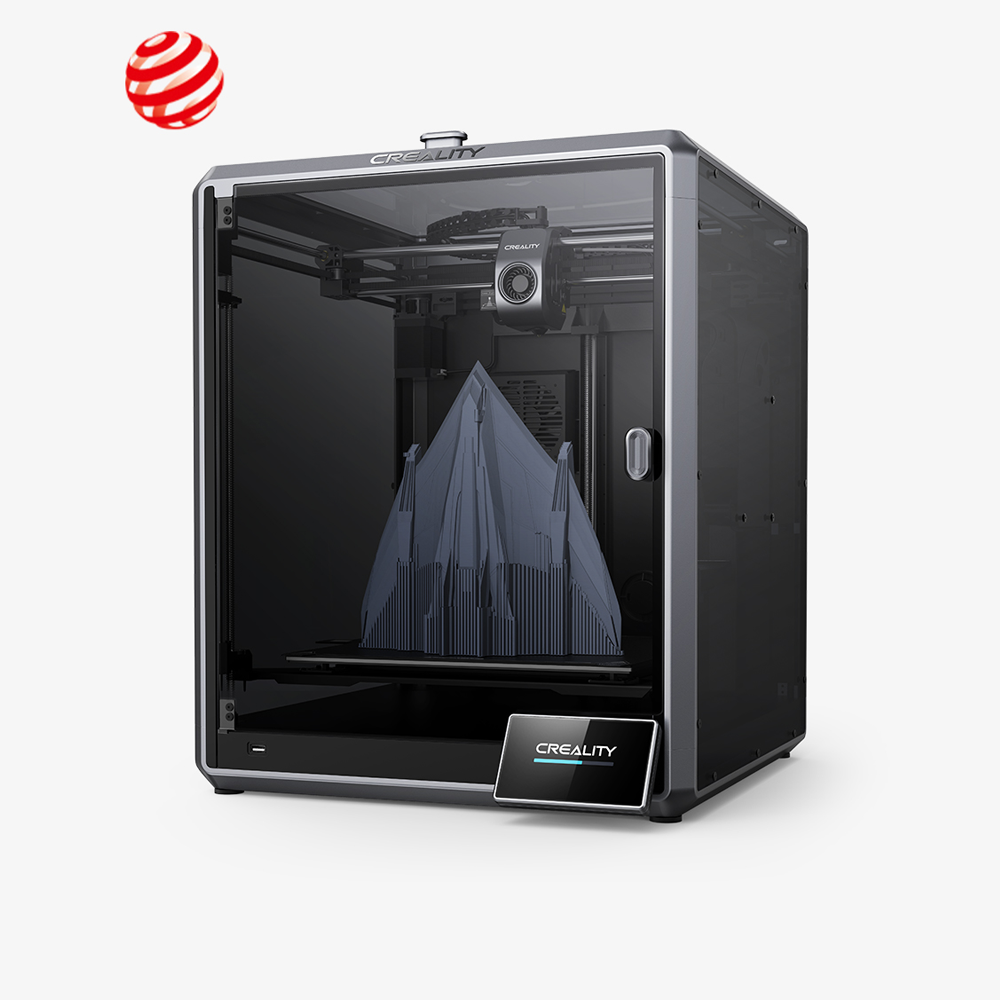
Enclosed 300 mm CoreXY printer rated at 600 mm/s, with an AI camera, LiDAR first-layer scanning and Ethernet.
$549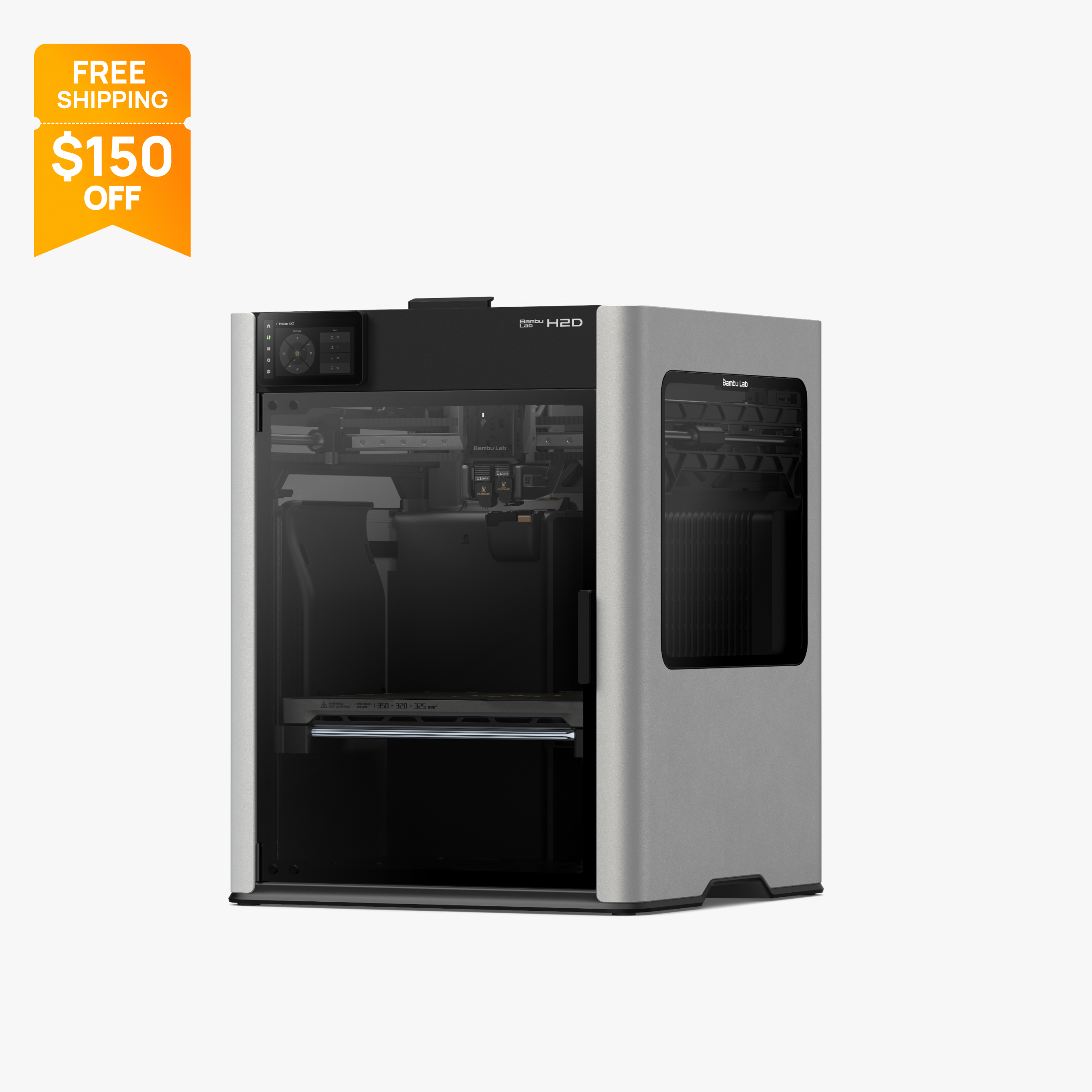
Large-format dual-nozzle printer with 350 °C hot ends, 65 °C heated chamber and optional laser module.
$1,399
Comparison table
| Spec | Creality K2 Plus | Sovol SV08 | Elegoo Neptune 4 Max | Creality K1 Max | Bambu Lab H2D |
|---|---|---|---|---|---|
| Type | FDM | FDM | FDM | FDM | FDM |
| Price | $999 | $529 | $394 | $549 | $1,399 |
| Build volume | 350×350×350 mm | 350×350×345 mm | 420×420×480 mm | 300×300×300 mm | 325×320×325 mm |
| Max speed | 600 mm/s | 700 mm/s | 500 mm/s | 600 mm/s | 1000 mm/s |
| Multicolor | Yes (CFS (optional; Combo includes 1 CFS for 4 colors, up to 4 CFS for 16 colors)) | No | No | No | Yes (Dual nozzle; AMS 2 Pro / AMS HT optional (AMS 2 Pro included only in the AMS Combo)) |
| Enclosed | Yes | No | No | Yes | Yes |
| Auto bed leveling | Yes | Yes | Yes | Yes | Yes |
| Connectivity | Wi-Fi (2.4 and 5 GHz), Ethernet, USB drive, Creality Cloud | Wi-Fi 2.4 GHz, Ethernet | Wi-Fi, WLAN, USB | Wi-Fi, Ethernet, USB drive, Creality Cloud | Dual-band Wi-Fi, USB |
| Noise | Not listed | Not listed | Not listed | Not listed | Not listed |
| Release year | 2024 | 2024 | 2023 | 2023 | 2025 |
How we chose
To count as a large 3D printer here, a printer needs at least 300 mm of build space in both X and Y, according to its maker's published specs. Five printers we cover qualify, and we ranked them by build volume, whether the frame is enclosed or has a heated chamber (which matters more as parts get bigger), motion system, nozzle and bed temperatures, and price. Picks are based on manufacturer specifications and official store prices, not lab tests. Prices are at the time of writing (October 2026) and change often. You can read more about our approach on the About Us page.
The picks
1. Creality K2 Plus: best large 3D printer overall
The Creality K2 Plus has a 350 x 350 x 350 mm build volume inside an enclosed CoreXY frame with active chamber heating to 60 °C. That combination matters for big parts: large ABS, ASA and nylon prints are the most prone to warping, and Creality says ABS, ASA and PPS need a 60 °C chamber. The 350 °C hardened steel nozzle and 120 °C bed open up PA-CF and PPA-CF, and Creality rates the motion system at 600 mm/s and 30,000 mm/s², with step-servo motors and automatic belt tensioning.
It is $999 without the CFS multicolor unit on Creality's US store at the time of writing (October 2026), down from a regular $1,299. The K2 Plus Combo with one four-color CFS is $1,199, and the printer supports up to four CFS units for 16 colors. Dual-band Wi-Fi, Ethernet, 32 GB of storage and a 1080p chamber camera are included.
Who it suits: makers who want one large printer for everything from cosplay armor to engineering parts. The tradeoffs: it weighs 35 kg according to Creality, Tom's Hardware heat-soaked the bed for 15 minutes before printing, and it measured more color-change purge waste than a Bambu Lab P1P. Compare it with Bambu's large-format option in Bambu Lab H2D vs Creality K2 Plus.
2. Sovol SV08: best value large CoreXY printer
The Sovol SV08 offers a 350 x 350 x 345 mm build volume for $529 on Sovol's US store at the time of writing (October 2026), down from a regular $599. That is almost the K2 Plus footprint for about half the price. Sovol publishes a 700 mm/s top speed and 40,000 mm/s² acceleration, among the highest figures we list, on a CoreXY frame.
Leveling a large bed is harder than a small one, and the SV08 handles it with quad gantry leveling: four independent Z motors plus inductive and pressure sensors. The hardware and software are open source, which makes repairs and upgrades straightforward, and Sovol says it ships about 90% pre-assembled with roughly an hour of setup. Wi-Fi, Ethernet and a built-in camera support remote monitoring.
Who it suits: makers printing big PLA and PETG parts who like to tinker. The tradeoffs: there is no enclosure in the base package, so large ABS and ASA parts are difficult; Sovol's bundle listings say the optional enclosure reduces build height to 330 mm. There is no official multicolor system, the nozzle tops out at 300 °C, and Wi-Fi works only on 2.4 GHz WPA2 networks.
3. Elegoo Neptune 4 Max: biggest build volume for the least money
The Elegoo Neptune 4 Max has the largest build volume we cover: 420 x 420 x 480 mm. It is $394 for the Type-C Version on Elegoo's US store at the time of writing (October 2026), down from a regular $559.99. It runs Klipper firmware with input shaping and pressure advance, and Elegoo lists up to 500 mm/s with 8,000 mm/s² acceleration. A 121-point automatic mesh compensates for unevenness across the large bed, and the 300 °C hotend with a dual-gear direct extruder handles PLA, PETG, TPU and nylon-class filaments.
Who it suits: prop makers and cosplayers who want full-size helmets or large panels in one piece on a tight budget.
The tradeoffs come from its design. It is a bed slinger, so the large bed moves back and forth and needs extra front-to-back clearance and a sturdy surface to limit vibration. Elegoo's default speed is 250 mm/s, so the 500 mm/s maximum is not an everyday figure. There is no enclosure, which makes big ABS and ASA parts hard to print, and the leveling system includes manual adjustment knobs that may need rechecking after the printer is moved. Only the Type-C Version is in stock on Elegoo's US store.
4. Creality K1 Max: best enclosed large printer under $600
The Creality K1 Max is a 300 x 300 x 300 mm enclosed CoreXY printer for $549 on Creality's US store at the time of writing (October 2026), down from a regular $899. It is the least expensive enclosed printer on this page. It includes a 300 °C hardened steel nozzle for abrasive filaments, an AI camera that watches for spaghetti and foreign objects, AI LiDAR first-layer scanning, and Wi-Fi plus Ethernet.
Creality rates it at up to 600 mm/s with 20,000 mm/s² acceleration, though the 600 mm/s figure came from a special Surface Mode, so typical speeds are lower.
Who it suits: buyers who want 300 mm parts in ABS or ASA and a cabinet that keeps heat and fumes contained, without paying for a heated chamber. The tradeoffs: there is no active chamber heater, so very large ABS or nylon parts can still warp in a cool room. There is no multicolor system, and the 100 °C bed limits some engineering materials. Creality's newer K2 Pro, also 300 x 300 x 300 mm, adds 60 °C chamber heating at a similar price, though Creality does not label it a K1 Max replacement.
5. Bambu Lab H2D: best large printer for engineering materials
The Bambu Lab H2D has a 325 x 320 x 325 mm single-nozzle build volume, active chamber heating to 65 °C and two 350 °C hot ends. Bambu says that supports PA, PC, PPS and fiber-reinforced engineering filaments. The two nozzles keep two materials or colors loaded at once, which cuts purging when a print switches between them, and filtration includes a G3 pre-filter, an H12 HEPA filter and activated carbon. Bambu lists a 1000 mm/s top speed and 20,000 mm/s² acceleration.
The base H2D is $1,399 and the H2D AMS Combo is $1,599 on Bambu's US store at the time of writing (October 2026). Optional 10 W or 40 W laser modules add engraving and cutting.
Who it suits: small studios and engineers who need large, strong parts in demanding materials, or two materials in one print. The tradeoffs: printing with both nozzles reduces the usable volume to 300 x 320 x 320 mm, the printer weighs 31 kg and measures 492 x 514 x 626 mm, and maximum power draw reaches 1320 W on 110 V circuits. If you only need large PLA and PETG, the SV08 or Neptune 4 Max cost a fraction of the price.
What to look for in a large format 3D printer
Build volume you will actually use. Measure the largest part you expect to print. A 256 mm printer such as the Bambu Lab P1S already handles many helmets and functional parts; it is only when parts exceed that, or when you want to print many copies on one plate, that a 300 mm or larger machine pays off. Large printers cost more, take more space and heat up more slowly.
Frame type. In a bed slinger, the bed moves along one axis, so a large, heavy bed has more mass to move and needs clearance in front of and behind the printer. The Neptune 4 Max is a bed slinger. In a CoreXY printer the bed only moves down, which keeps the footprint closer to the frame size; the K2 Plus, SV08, K1 Max and H2D are CoreXY. Our guide on how a 3D printer works explains the motion systems.
Enclosure and chamber heat. Bigger parts are more likely to warp because they shrink over a longer distance as they cool. Prusa's ABS guide puts ABS shrinkage at about 1 to 2% and recommends an enclosure with a higher ambient temperature. If you want large ABS, ASA or nylon parts, choose an enclosed printer, and for the biggest parts, a heated chamber (K2 Plus, H2D).
Bed leveling. Small errors grow across a big bed. Look for strong automatic leveling: the SV08's quad gantry leveling, the Neptune 4 Max's 121-point mesh, or the K1 Max's LiDAR first-layer scan.
Weight, size and power. The K2 Plus weighs 35 kg and the H2D 31 kg. The H2D can draw up to 1320 W on 110 V circuits, so avoid sharing its outlet with other heavy loads. Check your bench and doorway before ordering.
Materials and nozzle. Large prints use a lot of filament. A hardened nozzle (K1 Max, K2 Plus) lets you print stiff carbon-fiber blends, which are popular for large functional parts.
Multicolor at scale. Only the K2 Plus (CFS, up to 16 colors) and H2D (dual nozzle plus optional AMS) offer an official multi-material option here. See our best multicolor 3D printers for more.
Big printer, big prints: practical tips
Long prints raise the stakes of a failure, so remote monitoring is worth having. The K2 Plus, K1 Max, SV08 and H2D all have built-in cameras. Power loss recovery and filament run-out sensors also matter more on prints that run for a day or more; check each printer's spec page for these features. Plan filament stock too: a single large helmet or panel can use most of a 1 kg spool.
Which large printer should you buy?
Start with materials. If you print only PLA, PETG and TPU, an open machine is enough: the Sovol SV08 gives a 350 mm CoreXY build for $529 and the Elegoo Neptune 4 Max gives the most volume, 420 x 420 x 480 mm, for $394 at the time of writing (October 2026). If you want ABS or ASA at large sizes, pay for an enclosure: the Creality K1 Max is the entry point at $549, and the Creality K2 Plus adds a 60 °C heated chamber and a 350 mm build for $999. If you print polycarbonate, nylon or fiber-reinforced parts, or want two materials in one job, the Bambu Lab H2D's 65 °C chamber, 350 °C hot ends and dual nozzles justify its $1,399 base price.
Then check your space. Bed slingers need room for the bed to travel, enclosed CoreXY machines need a heavy-duty bench, and the biggest printers need an outlet that is not shared with other high-draw equipment. If none of this fits your room, a 256 mm printer may be the better buy.
What changed this update
- The QIDI Plus4 (305 x 305 x 280 mm, enclosed with a heated chamber) is discontinued and sold out on QIDI's store; its successor is the QIDI Plus5.
- The Bambu Lab X1 Carbon, Elegoo Centauri Carbon and other 256 mm printers never met this page's 300 mm criterion; if you do not need a large build, our best enclosed 3D printers page covers them.
Frequently asked questions
What is the best large 3D printer?
For most people it is the Creality K2 Plus, with a 350 x 350 x 350 mm enclosed build volume and a 60 °C heated chamber for $999 at the time of writing (October 2026). On a tighter budget, the Sovol SV08 offers 350 x 350 x 345 mm for $529 without an enclosure.
What is the biggest 3D printer for home use?
Among the printers we cover, the Elegoo Neptune 4 Max has the largest build volume at 420 x 420 x 480 mm. It is an open-frame bed slinger, so it needs extra clearance for the moving bed and is best suited to PLA, PETG and TPU.
What counts as a large format 3D printer?
On this page, a large printer has at least 300 mm of build space in both X and Y. Most popular consumer printers are around 220 to 256 mm per side, so 300 mm and up is a clear step larger.
Do large 3D printers need an enclosure?
For PLA and PETG, no. For ABS, ASA and nylon, large parts are more likely to warp, so an enclosure helps and a heated chamber helps more. The Creality K2 Plus and Bambu Lab H2D have actively heated chambers, and the Creality K1 Max has a passive enclosure.
Is a big 3D printer slower?
Not necessarily per layer, but large parts take longer simply because there is more to print. Large CoreXY printers such as the Sovol SV08 and Creality K2 Plus publish high speed and acceleration figures, while a large bed slinger like the Neptune 4 Max has more mass to move along one axis.
How much space does a large 3D printer need?
Plan for more than the build volume. The Bambu Lab H2D measures 492 x 514 x 626 mm and weighs 31 kg, and the Creality K2 Plus weighs 35 kg. Bed slingers also need clearance in front and behind for the moving bed.
Sources
- Creality US store, K2 Plus (official)
- Creality US store, K2 Plus Combo (official)
- Creality K2 Plus CFS Combo support and specifications (official)
- Tom's Hardware: Creality K2 Plus review
- Sovol SV08 product page (official store)
- Elegoo Neptune 4 Max, US store product page (official)
- Creality US store, K1 Max 2025 (official)
- Creality K1 Max support and parameters (official)
- Bambu Lab H2D technical specifications (official)
- Bambu Lab H2D on the official US store (prices by configuration)
- Prusa Knowledge Base: ABS material guide