Centauri Carbon 2 vs Bambu Lab P2S

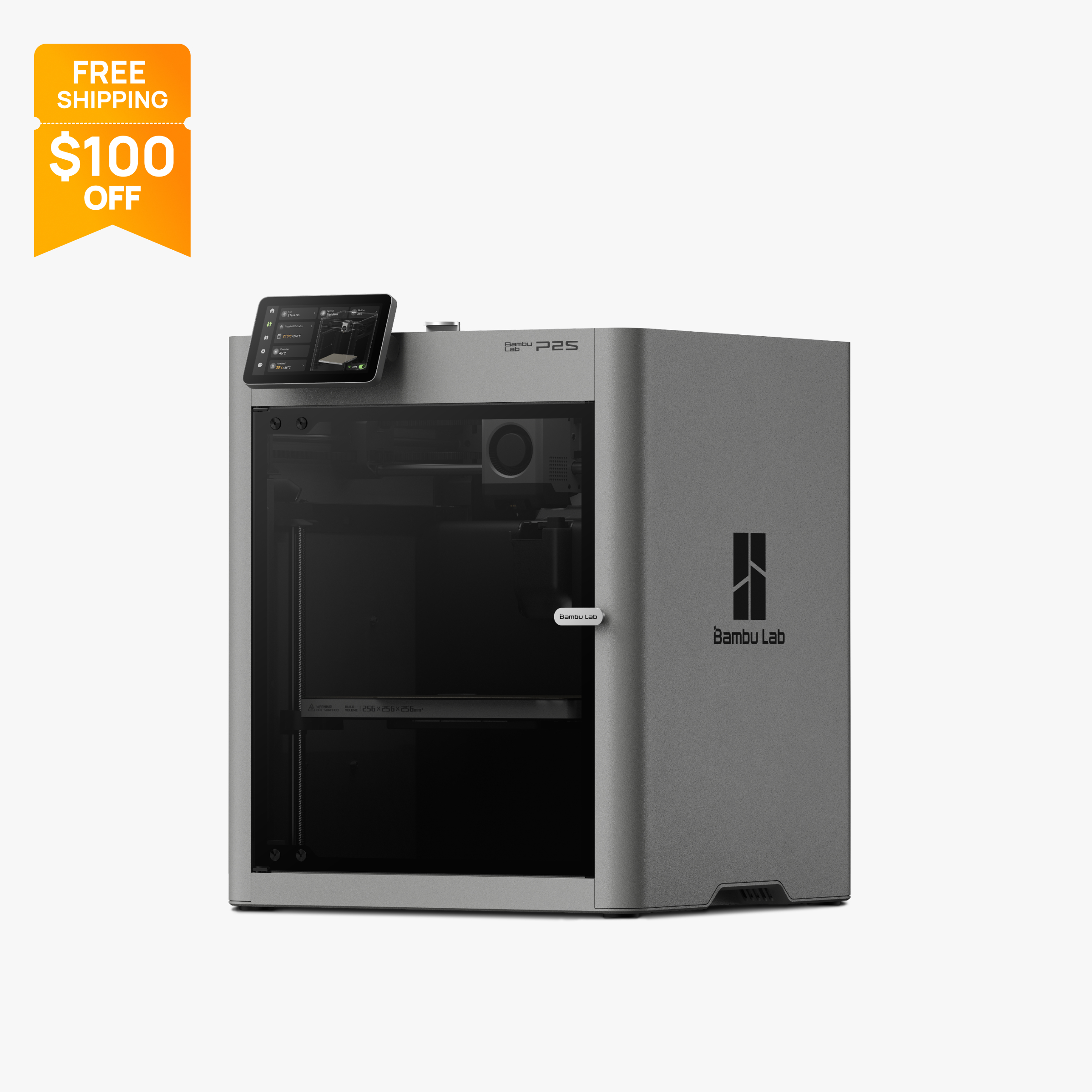
Verdict
Buy the Centauri Carbon 2 if you want the cheaper enclosed CoreXY printer, mostly print one color, and like its 350 °C hardened nozzle and HEPA filter. Buy the P2S if you want up to 20 colors, higher 600 mm/s and 40 mm³/s ratings and a 30 fps camera. Neither has a heated chamber.
Specs side by side
| Spec | Centauri Carbon 2 | Bambu Lab P2S |
|---|---|---|
| Type | FDM | FDM |
| Price | $349 | $449 |
| Build volume | 256×256×256 mm | 256×256×256 mm |
| Max speed | 500 mm/s | 600 mm/s |
| Multicolor | Yes (CANVAS (optional, sold separately; 4 colors)) | Yes (AMS 2 Pro / AMS HT (optional; AMS 2 Pro included in the P2S Combo; up to 8 units and 20 colors)) |
| Enclosed | Yes | Yes |
| Auto bed leveling | Yes | Yes |
| Connectivity | Wi-Fi, LAN, USB flash drive | Dual-band Wi-Fi, USB |
| Noise | 45 dB | Not listed |
| Release year | 2026 | Not listed |
Quick answer
In the Centauri Carbon 2 vs P2S match-up, pick the Elegoo Centauri Carbon 2 if you want an enclosed CoreXY printer with a hardened nozzle for the lowest price, plan to print mostly one color, and like the hotter 350 °C hot end and HEPA filtration. Pick the Bambu Lab P2S if multicolor printing is important, since it scales to 20 colors, or if you want the higher 600 mm/s speed rating, a 40 mm³/s flow rating and a 1080p camera at 30 fps. On paper these two are close: same 256 mm cube build volume, 20,000 mm/s² acceleration, 110 °C bed, 5-inch touchscreen, and no active chamber heater on either.
Key differences
What is the same
It helps to start with how much these printers share, because it narrows the decision. Both are enclosed CoreXY machines with a 256 x 256 x 256 mm build volume and 20,000 mm/s² acceleration. Both have a 110 °C bed and a 5-inch touchscreen. Both ship with a hardened steel nozzle, so carbon fiber filled PLA and PETG work without a hardware swap. And neither has an active chamber heater: Bambu's FAQ confirms the P2S relies on its enclosure and an airflow flap, and Tom's Hardware's review of the Centauri Carbon 2 Combo lists the lack of a chamber heater as a con.
So neither is the pick for large nylon or polycarbonate parts that need a held chamber temperature. Both can print ABS and ASA thanks to the enclosure. The differences below are about the hot end, speed, filtration, multicolor, connectivity and price.
Hot end temperature and flow
Elegoo lists a 350 °C hot end on the Centauri Carbon 2 with a hardened steel nozzle and a 32 mm³/s flow rate. Bambu lists 300 °C on the P2S with a hardened steel nozzle, a hardened steel extruder gear driven by a PMSM servo motor, and a 40 mm³/s rated maximum flow.
The higher nozzle limit gives the Centauri Carbon 2 more headroom for filaments that like hotter printing. Elegoo's page mentions PLA, PETG, PC, PET and fiber-reinforced filaments, and Tom's Hardware's Combo review lists PLA, PETG, TPU, ABS, ASA, PA and PC. Bambu's P2S spec sheet lists PLA, PETG, ABS, ASA, TPU, PET, PA, PC and PVA plus fiber grades such as PLA-CF, PETG-CF, ABS-GF, PA6-CF and PPA-CF.
The higher flow rating on the P2S matters for fast printing, because flow limits how much plastic the hot end can melt per second. It pairs with the next difference.
Speed ratings
Bambu rates the P2S at 600 mm/s. Elegoo rates the Centauri Carbon 2 at 500 mm/s. Acceleration is the same at 20,000 mm/s².
On most real parts, acceleration and hot end flow do more to set print time than top speed, because short moves and corners rarely let the head reach full speed. With matching acceleration, the P2S's advantage on paper comes from its higher top speed and its 40 against 32 mm³/s flow rating, which matters most on large, simple parts printed with thick layers. For small, detailed parts the two ratings suggest little difference. These are maker figures, not measured print times.
Filtration and chamber airflow
Elegoo lists a composite HEPA plus coconut shell activated carbon filter on the Centauri Carbon 2, and an auto-controlled smart grille on the chamber. Bambu lists an activated carbon filter on the P2S and an automatic flap that switches between internal and external circulation.
The HEPA stage is designed to catch fine particles, and the carbon stage targets odors and fumes. If you plan to print ABS or ASA in a shared room, the Centauri Carbon 2's listed HEPA filter is a point in its favor. Either way, good room ventilation is still the safer setup for those materials.
Multicolor systems
This is the largest practical difference. The base Centauri Carbon 2 prints one filament at a time. Elegoo sells it as "Multicolor Upgrade Ready", with the CANVAS unit sold separately, and also sells a Centauri Carbon 2 Combo that includes CANVAS. Tom's Hardware's review of the Combo describes CANVAS as a 4-color system.
The P2S works with the AMS 2 Pro and AMS HT. Bambu's store FAQ says it can connect up to four AMS 2 Pro and four AMS HT units, 20 slots in total, for up to 20 colors. The P2S Combo includes one AMS 2 Pro, which can dry filament, though drying during a print needs an official power adapter that is not included.
If you want 4 colors at most, both can get there. If you want more, or want drying built into the filament system, the P2S has far more room to grow. See our best multicolor 3D printers for other systems.
Connectivity, camera and noise
Tom's Hardware's Centauri Carbon 2 Combo review lists LAN, Wi-Fi and USB flash drive printing and notes that it does not need cloud access. Elegoo lists ElegooSlicer and the ELEGOO Matrix app for remote monitoring, and its global page lists a chamber camera. Elegoo does not list the camera resolution in the data used here.
The P2S lists dual-band Wi-Fi and USB with 8 GB of eMMC storage, and no Ethernet port. Its camera is 1920 x 1080 at 30 fps, backed by a 2 TOPS neural processing unit for AI error detection. Bambu Studio is the main slicer, and Bambu says third-party slicers that export standard G-code are supported, with some advanced features possibly unavailable.
On noise, Elegoo lists the Centauri Carbon 2 at under 45 dB, but only in Silent Mode with the auxiliary part fan off, not during normal printing. Bambu does not list a P2S noise figure in the data used here, so this page cannot say which is quieter.
Calibration, frame and build plate
Elegoo lists automatic leveling, auto Z offset, active vibration compensation and pressure advance calibration on the Centauri Carbon 2, using what it calls 18 smart sensors. The motion system uses dual 4260 stepper motors on a die-cast aluminum frame. The bed has a dual-sided flexible plate with a PLA side and a textured PEI side.
The P2S uses a flexible steel plate with a textured PEI surface. Bambu ships a 0.4 mm nozzle and supports 0.2, 0.6 and 0.8 mm sizes, and its wiki documents a manual bed tramming procedure for the P2S heatbed if it ever needs servicing.
Both printers are designed so that everyday prints start without manual leveling. The Centauri Carbon 2's dedicated PLA side on its plate is a small convenience for buyers who print PLA most of the time, while the P2S's textured PEI plate is the single surface for everything.
Review notes and warranty
Tom's Hardware's Centauri Carbon 2 Combo review reported that the cold plate was not sticky enough and that the spool holders do not fit many third-party spools well. Elegoo lists a 12-month warranty on the machine and 6 months on the extruder and printhead kit. Bambu's US store lists a 2-year warranty and 30-day returns on the P2S at the time of writing. This page cites no comparable review notes for the P2S.
Price and what you get
At the time of writing (late October 2026), Elegoo's US store lists the Centauri Carbon 2 base printer at $349, against a regular price of $359. Elegoo's page sometimes shows promotions, so check the store for the price at checkout. For the Centauri Carbon 2 Combo with CANVAS, check Elegoo's store, since this page has no verified price for it.
Bambu's US store lists the P2S at $449 for the printer alone during a Black Friday sale (typical price $549), and the P2S Combo with an AMS 2 Pro at $649 (typical $749). Sale prices change often.
For a single-color printer, the Centauri Carbon 2 costs $100 less than the P2S at sale prices and gives you a hotter nozzle and HEPA filtration. The P2S asks more for a higher speed and flow rating, a 1080p camera at 30 fps, and an ecosystem that scales to 20 colors.
Who should buy which
Buy the Elegoo Centauri Carbon 2 if:
- You want the lowest price for an enclosed CoreXY printer with a hardened nozzle.
- You print mostly one color, or 4 colors is enough with CANVAS later.
- You want a 350 °C hot end and HEPA plus carbon filtration.
- You want LAN, Wi-Fi or USB flash drive printing that Tom's Hardware confirms needs no cloud access.
Buy the Bambu Lab P2S if:
- You want more than 4 colors, up to 20, or filament drying in the AMS 2 Pro.
- You value the higher 600 mm/s and 40 mm³/s ratings for large parts.
- You want a 1080p camera at 30 fps with AI error detection.
- You want Bambu Studio and Bambu's app as one integrated system.
Also consider
- The Bambu Lab P1S, $349 on sale (regular $399), if you want Bambu's AMS ecosystem at the Centauri Carbon 2's price and can accept a stainless steel nozzle and 100 °C bed. See P2S vs P1S.
- The QIDI Q2, $499, if you need active chamber heating to 65 °C and a 370 °C nozzle for engineering materials. See QIDI Q2 vs P2S.
- The Anycubic Kobra S1 ACE 2 Pro Combo, $499, if you want an enclosed printer with a 4-color unit included in the box.
For the previous generation, read Centauri Carbon vs P1S. For more choices, see best enclosed 3D printers, best budget 3D printers and best 3D printers under $500.
Frequently asked questions
What is the difference between the Centauri Carbon 2 and the P2S?
Both are enclosed CoreXY printers with a 256 mm cube build volume, 20,000 mm/s² acceleration, a 110 °C bed and a hardened steel nozzle. The Centauri Carbon 2 reaches 350 °C and lists HEPA plus carbon filtration, while the P2S lists 600 mm/s, 40 mm³/s flow and support for up to 20 colors.
Does either printer have a heated chamber?
No. Bambu's FAQ confirms the P2S has no active chamber heating, and Tom's Hardware's review of the Centauri Carbon 2 Combo lists the lack of a chamber heater as a con. Both rely on their enclosures to hold heat.
Can the Centauri Carbon 2 print multicolor like the P2S?
Only with the separately sold CANVAS unit, or by buying the Centauri Carbon 2 Combo. Tom's Hardware's review of the Combo describes CANVAS as a 4-color system. The P2S can connect up to eight AMS units for up to 20 colors.
Which is cheaper, the Centauri Carbon 2 or the P2S?
At the time of writing (October 2026), Elegoo's US store lists the Centauri Carbon 2 at $349 (regular $359), and Bambu lists the P2S at $449 on sale (typical $549). Both stores change prices often.
Can both printers print carbon fiber filament?
Yes. Both ship with a hardened steel nozzle. Elegoo's page mentions fiber-reinforced filaments, and Bambu's P2S spec sheet lists PLA-CF, PETG-CF, ABS-GF and PA6-CF as supported.
Does the Centauri Carbon 2 need the cloud?
No. Tom's Hardware's review of the Centauri Carbon 2 Combo notes it needs no cloud access and lists LAN, Wi-Fi and USB flash drive printing. Elegoo also offers the ELEGOO Matrix app for remote monitoring.
Sources
- Elegoo Centauri Carbon 2, US store (official, price)
- Elegoo Centauri Carbon 2, global store (official)
- Tom's Hardware: Elegoo Centauri Carbon 2 Combo review
- Bambu Lab P2S technical specifications (official)
- Bambu Lab P2S on the official US store (price, combo contents, FAQ)
- Bambu Lab P2S spec sheet PDF (official, linked from the US store)
- Bambu Lab US store 3D printer collection (lineup and prices)
- P2S & X2D Heatbed Manual Bed Leveling (Bambu Lab Wiki)
- Bambu Lab P1S on the official US store (price)
- Anycubic Kobra S1 ACE 2 Pro Combo, official store (price)