QIDI Q1 Pro vs Creality K1C
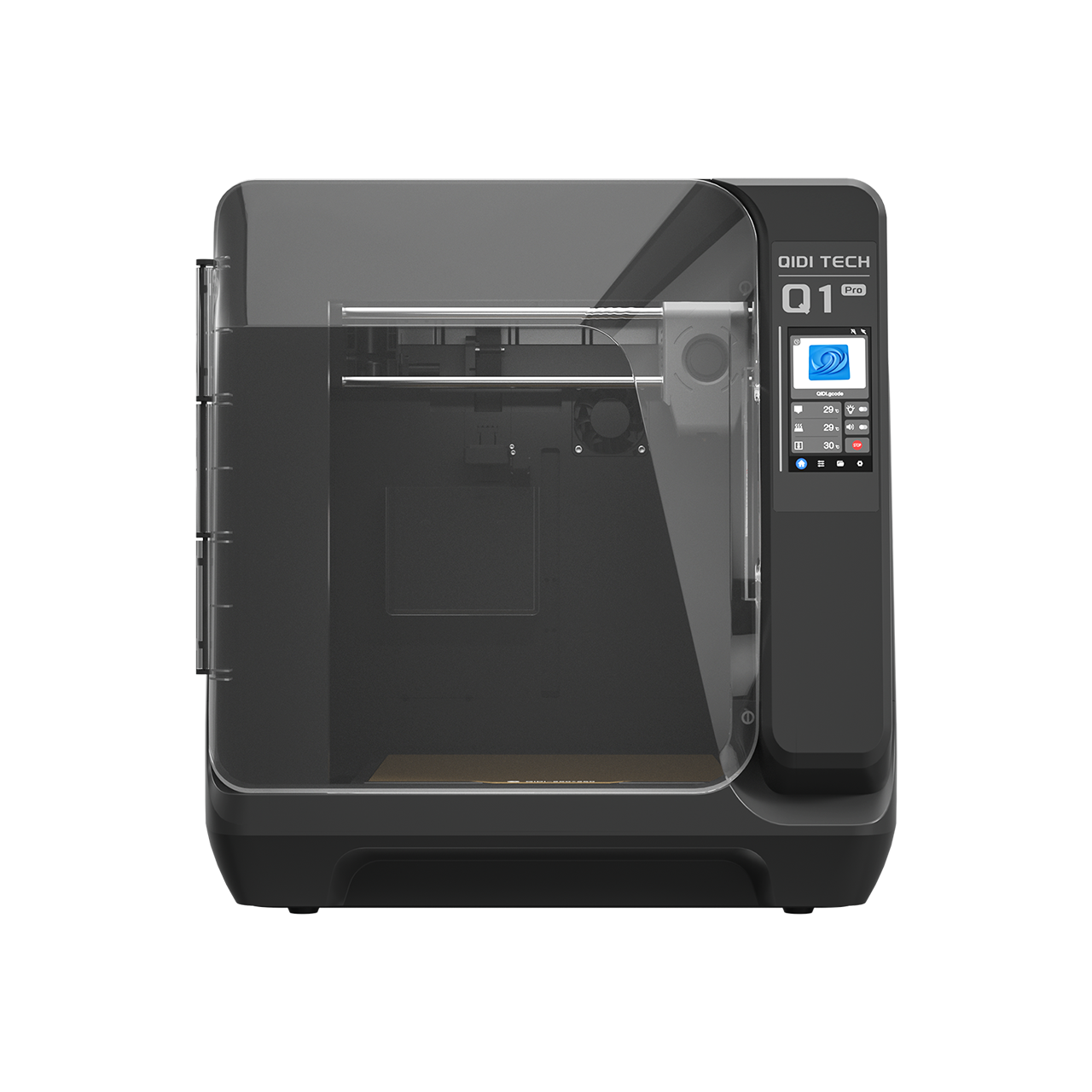

Verdict
The Q1 Pro is discontinued, so this matters mainly for used buyers and owners. It has the hotter chamber and nozzle; the K1C is the one you can buy new at $499 (October 2026). If you want a QIDI, look at its successor, the Q2.
Specs side by side
| Spec | QIDI Q1 Pro | Creality K1C |
|---|---|---|
| Type | FDM | FDM |
| Price | Check current price | $499 |
| Build volume | 245×245×240 mm | 220×220×250 mm |
| Max speed | 600 mm/s | 600 mm/s |
| Multicolor | No | No |
| Enclosed | Yes | Yes |
| Auto bed leveling | Yes | Yes |
| Connectivity | Wi-Fi 2.4 GHz, USB flash drive | Wi-Fi, USB drive, Creality Cloud |
| Noise | Not listed | Not listed |
| Release year | 2024 | 2024 |
Quick answer
The QIDI Q1 Pro is no longer sold new: qidi3d.com states that the model has been discontinued and is no longer in production, and the product is marked sold out. QIDI says spare parts and support remain available for owners. This page is still useful if you are comparing used units, deciding whether to upgrade, or reading older reviews.
On specifications, the Q1 Pro offers more chamber heat (60°C), a hotter nozzle (350°C) and a 120°C bed than the Creality K1C, which has no heated chamber, a 300°C nozzle and a 100°C bed. The K1C is still sold new. If you are buying today, the practical choices are the K1C, QIDI's successor Q2, or another current enclosed printer.
Key differences
Chamber heating and materials
This is where the Q1 Pro pulls ahead. QIDI lists active chamber heating to 60°C in a compact enclosed frame, a 350°C hotend and a 120°C bed. That combination helps with ABS, ASA and other warp-prone materials, and supports many engineering and filled filaments.
The K1C is enclosed, but Creality lists no active chamber heater, so large ABS or nylon parts may still warp in cooler rooms. Its all-metal hotend and hardened steel nozzle reach 300°C, and Creality lists PLA-CF and PA-CF among supported filaments. The 100°C bed limit may restrict some engineering materials that prefer hotter beds.
For PLA, PETG and small ABS parts, the two printers overlap. For nylon, polycarbonate-style materials or large ABS parts, the Q1 Pro's chamber and temperature headroom matter. If that is your use case, the practical answer today is a current actively heated printer, such as QIDI's Q2 or the options on our best enclosed 3D printers page. The materials page explains temperature needs by filament.
Build volume
The Q1 Pro lists 245 x 245 x 240 mm and the K1C lists 220 x 220 x 250 mm. That is about 14.4 liters against about 12.1 liters of nominal volume, so the Q1 Pro offers roughly 19 percent more space, with a larger footprint but 10 mm less height. Parts that need height favor the K1C slightly, and everything else favors the Q1 Pro.
QIDI's successor, the Q2, lists 270 x 270 x 256 mm, a larger volume again, with a 370°C nozzle and a 65°C chamber. If build volume is a priority and you are buying new, the Q2 is a stronger candidate than either of these two.
Neither printer is large-format. If you need more than 250 mm in any direction, see best large-format 3D printers.
Speed and motion
On paper the two are identical: QIDI lists 600 mm/s and 20,000 mm/s² for the Q1 Pro, and Creality lists the K1C at 600 mm/s with 20,000 mm/s² acceleration in an enclosed CoreXY frame. Both numbers are ceilings, and real print times depend on layer height, part shape and profile settings. With matching headline numbers, the spec sheet does not pick a winner, so decide on chamber, volume, price and support instead.
Creality lists plus or minus 0.1 mm accuracy on a 100 mm part for the K1C. QIDI's data we reviewed does not publish a comparable accuracy figure, so do not read the K1C's number as a verdict. It is a manufacturer claim for one part size, and the Q1 Pro may perform similarly. If dimensional accuracy is critical for your work, plan to calibrate whichever printer you choose and check the first few parts with calipers.
Connectivity, camera and software
The Q1 Pro lists 2.4 GHz Wi-Fi and a USB flash drive, with a 4.3 inch touchscreen and a low-frame-rate camera (up to 1080P) that supports timelapse. QIDI's page is inconsistent about Wi-Fi (the spec table says a 2.4G module while a feature section mentions Wi-Fi 6), so the 2.4 GHz module may be less convenient on networks that only broadcast 5 GHz.
The K1C lists Wi-Fi, a USB drive and Creality Cloud, also with a 4.3 inch screen, and Creality's store page advertises an AI camera. Creality lists support for Creality Print, PrusaSlicer, Cura and Simplify3D, so you are not locked into one slicer.
For QIDI's slicer and app details, check QIDI's support pages for your unit, since this data is not part of the verified specs. If you own a Q1 Pro, QIDI's statement that support and spare parts remain available is the key reassurance.
Multicolor and the successor path
The Q1 Pro has no multicolor system. Creality's K1C store page says the K1C 2025 is set to unlock multicolor printing with the new CFS and that launch details are still to come, so treat the K1C as single-material until Creality publishes them. Creality's newer K2 is enclosed, 260 x 260 x 260 mm, and takes the optional CFS. Creality does not label the K2 a K1C replacement, but it is the nearest option for multicolor in the same brand. On 2026-10-28 its store showed the base K2 as out of stock with an estimated shipping date of November 6.
QIDI's successor path is clearer: the Q2 is the named successor, and a Q2 Combo with the QIDI Box lists at $649 on qidi3d.com for the ship-from-China option. If multicolor matters to you, that is a stronger fit than either printer here. See best multicolor 3D printers. The K2 and the Q2 are separate products from the printers on this page, so check their current listings for full specifications before relying on any figure here.
If you own a Q1 Pro
Owners are in a better position than the word discontinued suggests. QIDI states that spare parts and support remain available for existing owners, so the printer does not become unsupported overnight. Keep a record of your firmware version and consumables, and check QIDI's support page for current parts before assuming a repair will be difficult.
The decision to upgrade is mostly about size and temperature. The Q2 lists 270 x 270 x 256 mm against the Q1 Pro's 245 x 245 x 240 mm, a 370°C nozzle against 350°C, and 65°C chamber heating against 60°C. The listed price is $499 for the ship-from-China option. If your Q1 Pro already covers your parts, there is no urgent reason to move, and the money may be better spent on filament and spares.
A checklist for buying a used Q1 Pro
Because the Q1 Pro is no longer sold new, a used purchase is the only way to get one. Ask for a short video of the printer heating the chamber and running a calibration or short print. Check that the touchscreen responds, that the bed heats to temperature, and that the enclosure panels and door are intact. Ask which nozzle and hotend parts have been replaced.
Confirm the Wi-Fi situation with your own network, because QIDI lists a 2.4 GHz module and the printer may not connect on a network that only broadcasts 5 GHz. Finally, ask what the seller paid and when they bought it, so you can judge wear. Keep the purchase price below what a new, supported alternative would cost, because a used unit comes without a store warranty.
Value: used Q1 Pro, new K1C or the Q2
If you want the strongest specifications for ABS and filled materials and can accept a used unit, the Q1 Pro is attractive on paper. If you want a new, warranted printer for PLA, PETG and small ABS parts, the K1C 2025 at $499 is available now. If you want the QIDI approach but new, the Q2 lists at $499 with larger volume and hotter limits, and the Q2 Combo adds the QIDI Box multicolor system at $649 (both for the ship-from-China option on qidi3d.com, which says orders ship within 7 business days).
Price alone will not decide it. The K1C's AI camera and multi-slicer support, the Q1 Pro's chamber heater and the Q2's larger volume all point to different buyers. Match the printer to the material you print most. For wider comparisons, see best 3D printers under $500 and best enclosed 3D printers.
Price and what you get
The Q1 Pro is discontinued and sold out on qidi3d.com, so this page states no price for it. Used prices vary by seller, so compare any listing against what a new printer costs today.
The Creality K1C is sold on Creality's US store as the K1C 2025 at $499 (regular $559) at the time of writing (October 2026). Creality's store page does not publish a separate spec sheet for the 2025 version, so the specs above come from the original K1C sources. Verify the version if you buy.
QIDI lists the successor Q2 at $499, and the Q2 Combo with the QIDI Box at $649, for the ship-from-China option on qidi3d.com (a Brazil-shipping option is listed at higher prices). Creality's newer K2 lists at $419 for the base printer on its US store, though it showed as out of stock on 2026-10-28. Prices change, so check each store before buying. See best 3D printers under $500 for more.
Who should buy which
Choose a used Q1 Pro if:
- You find one at a clear discount and want active chamber heating and a 350°C hotend.
- You mainly print ABS, ASA or filled materials and have a spare-parts plan with QIDI.
- You already own one and are deciding whether to keep it or upgrade.
Choose the K1C if:
- You want a new printer from a current product line with a US store listing.
- You print mostly PLA, PETG and small ABS or ASA parts in an enclosure.
- You want a built-in AI camera and support for several slicers.
- You prefer buying from a store with clear stock; see best enclosed 3D printers.
Also consider
- Creality K1 Max at $549 (regular $899) offers a 300 x 300 x 300 mm enclosed volume, though it has no multicolor system.
- Bambu Lab P1S at $349 (regular $399) is a lower-cost enclosed printer with optional AMS multicolor.
- Prusa Core One is an enclosed printer with active chamber heating to 55°C; check prusa3d.com for its current price.
You can also read best 3D printers under $1,000 and best for small business for more options.
Frequently asked questions
Is the QIDI Q1 Pro discontinued?
Yes. qidi3d.com states that the model has been discontinued and is no longer in production, and the product page shows it sold out. QIDI says spare parts and support remain available for existing owners.
What replaced the QIDI Q1 Pro?
QIDI names the Q2 as the successor. It lists 270 x 270 x 256 mm, a 370°C nozzle and 65°C chamber heating, at $499 on qidi3d.com (ship-from-China option), with a Q2 Combo including the QIDI Box at $649.
Is the Creality K1C still sold?
Yes. Creality's US store sells the K1C 2025 at $499 (regular $559) as of 2026-10-28, though it does not publish a separate spec sheet for that version.
Which is better for ABS, the Q1 Pro or the K1C?
On specifications, the Q1 Pro, which lists 60°C active chamber heating, a 350°C hotend and a 120°C bed. The K1C is enclosed but has no chamber heater, so large ABS parts may still warp in cooler rooms.
Do the Q1 Pro or K1C support multicolor printing?
The Q1 Pro has none. Creality says the K1C 2025 is set to unlock multicolor with the new CFS but has not published launch details. QIDI's successor Q2 Combo adds the QIDI Box, and Creality's newer K2 supports an optional CFS.
Which has the bigger build volume, the Q1 Pro or the K1C?
The Q1 Pro lists 245 x 245 x 240 mm and the K1C lists 220 x 220 x 250 mm. The Q1 Pro has more floor area and the K1C is 10 mm taller.