Elegoo Centauri Carbon vs Bambu Lab P1S

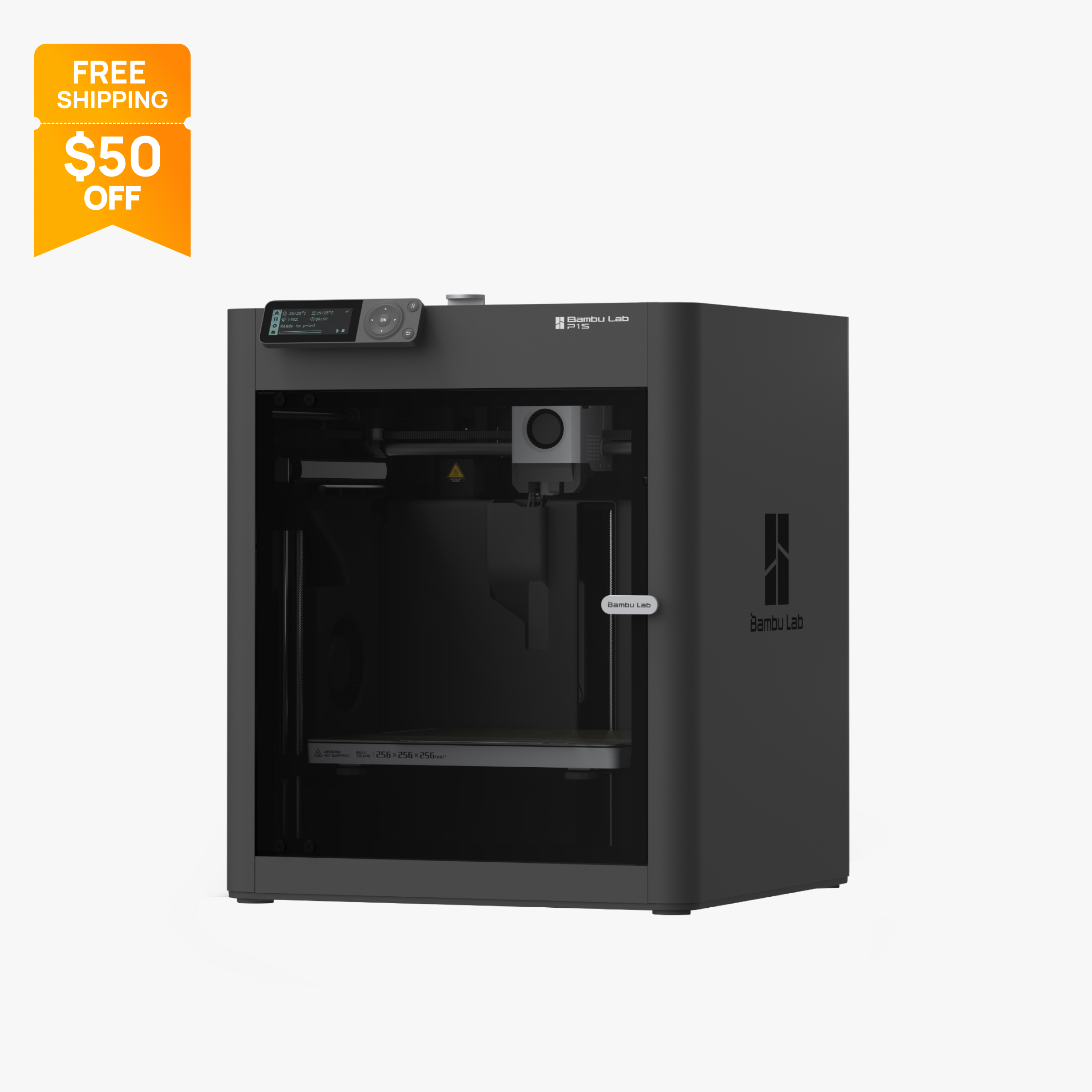
Verdict
The Centauri Carbon is no longer sold new on Elegoo's US store, so this page suits used buyers and owners. It lists a 320 °C hotend with a brass-hardened steel nozzle and a 110 °C bed; the P1S is still sold, takes up to 16 colors with AMS and is the safer new purchase. If you prefer Elegoo, look at the Centauri Carbon 2.
Specs side by side
| Spec | Elegoo Centauri Carbon | Bambu Lab P1S |
|---|---|---|
| Type | FDM | FDM |
| Price | Check current price | $349 |
| Build volume | 256×256×256 mm | 256×256×256 mm |
| Max speed | 500 mm/s | 500 mm/s |
| Multicolor | Yes (CANVAS for Centauri Carbon (optional accessory listed by Elegoo)) | Yes (AMS or AMS 2 Pro (optional, up to 16 colors with 4 units)) |
| Enclosed | Yes | Yes |
| Auto bed leveling | Yes | Yes |
| Connectivity | Wi-Fi, camera | Wi-Fi, Bluetooth, Bambu-Bus, microSD |
| Noise | Not listed | 48 dB |
| Release year | 2025 | 2023 |
Quick answer
The Elegoo Centauri Carbon is no longer sold new on Elegoo's US store: the US product page returns an error, the Centauri series collection lists only the Centauri Carbon 2 and Centauri 2 families, and the only original listing is a pre-owned unit marked out of stock. This page is still useful if you are weighing a used Centauri Carbon, own one and wonder how it compares with Bambu's P1S, or are reading older reviews. On specs the Centauri Carbon lists a hotter hotend and a brass-hardened steel nozzle, while the P1S is still sold and supports up to 16 colors with several AMS units. If you are buying new today, compare the P1S with Elegoo's Centauri Carbon 2.
Key differences
Availability
The practical difference comes first. Bambu's P1S was listed and in stock on its US store on October 28, 2026, and Bambu has not announced an end of life for it. The Centauri Carbon was not on Elegoo's US store that day. Elegoo's own site banner promotes the Centauri Carbon 2 as the new release, and Elegoo's global site still has a product page for the original, though the price shown there is not a US store price.
For a US buyer, that means a Centauri Carbon is now a used or leftover-stock purchase. You are dependent on whatever warranty and support terms the seller or Elegoo's certified pre-owned program offers, so check those before you pay. By contrast, the P1S can be bought new from the maker's own store.
Nozzle, temperature and materials
Both are enclosed CoreXY printers with a 256 x 256 x 256 mm build volume, 500 mm/s top speed and 20,000 mm/s² acceleration. The materials story is where they diverge. The Centauri Carbon lists a 320 °C hotend with a brass-hardened steel nozzle, which Elegoo positions for carbon fiber filled filaments. Tom's Hardware's review, however, said the nozzle can be swapped for a hardened steel one sold by Elegoo, so confirm which nozzle a used unit carries before printing abrasive filaments. The P1S tops out at 300 °C and ships with a stainless steel nozzle, and Bambu says fiber-reinforced filaments are not recommended until the extruder and hot end are upgraded.
The Centauri Carbon also lists a 110 °C bed, against 100 °C on the P1S. Neither printer has an active chamber heater: Elegoo lists a fully enclosed chamber without naming a heater, Tom's Hardware lists the lack of a chamber heater as a drawback, and the P1S has no active chamber heating either. So both enclosures are passive, and PA and PC remain demanding materials on either machine.
If carbon fiber filled filaments are your reason to buy, the Centauri Carbon's listed hardened nozzle and higher hotend temperature are the points in its favor, subject to the nozzle check above.
Multicolor
The P1S has the more developed multicolor system. It supports Bambu's AMS and AMS 2 Pro, and Bambu says up to four units can be connected for as many as 16 colors or materials in a single print. Bambu also offers an AMS 2 Pro Combo that adds active filament drying.
The Centauri Carbon is a single-filament printer by default. Elegoo lists CANVAS for Centauri Carbon as an optional accessory for multicolor printing, which means you buy it separately if you want more than one filament at a time. Compare what the CANVAS system supports with the AMS before you assume the two are equal; see our best multicolor 3D printers page for other options.
Build quality notes from reviewers
Elegoo's own spec sheet is only one view. Tom's Hardware reviewed the Centauri Carbon and noted several issues that you should weigh if you are buying one used. The reviewer called the interior light abysmally dim and said the camera feed was dimly lit too. They reported that the smooth cool plate side had a weak grip at the suggested 30 °C bed temperature, with better results at 60 °C. They also noted a serious bend in the Bowden tube near the toolhead, and TPU had to be hand-fed the last few centimeters.
These are one publication's observations about one unit, not universal defects, and firmware and settings may have changed since. They are still useful as a checklist if you inspect a used printer. Elegoo lists automatic leveling, Z offset, vibration and pressure advance calibration, so setup needs little manual tuning, and the printer includes a built-in chamber camera.
Software and ecosystem
The P1S runs on Bambu Studio and the Bambu app, with Wi-Fi, Bluetooth, Bambu-Bus and microSD connectivity. Bambu says third-party slicers that export standard G-code, such as PrusaSlicer, SuperSlicer and Cura, are supported, though some advanced features may not be available.
The verified data for this page does not list the Centauri Carbon's connectivity options or screen size, so check Elegoo's product page for those details if they matter to your decision. If you are used to Bambu's tightly integrated slicer, app and AMS, expect that part of the experience to differ on an Elegoo machine.
The P1S also has a 2.7-inch screen that is small and button-driven, so most control there happens through the app or slicer.
Speed and build volume
On the numbers that most buyers compare first, these printers are effectively tied. Both list a 256 x 256 x 256 mm build volume, a 500 mm/s top speed and 20,000 mm/s² acceleration, and both are CoreXY machines with an enclosure and automatic bed leveling. That means neither wins on part size or on the rated speed of the motion system, and your print times will depend far more on slicer profiles, layer height and part geometry than on which brand you pick.
The one build volume caveat is on the Bambu side: Bambu Studio defaults the P1S's printable height to 250 mm to protect the heatbed, and using the full 256 mm needs extra steps from Bambu's wiki. This is a minor point for most prints, but it matters if you design parts that use the full height. Both printers are large enough for most functional parts, helmets and organizers in one piece, and our best large-format 3D printers page lists machines for bigger jobs.
Checklist if you are buying a used Centauri Carbon
Because there is no new-unit price or warranty to lean on, a used purchase should be inspected. Based on Elegoo's spec sheet and the reviewer notes above, here is what to check:
- Run a first-layer test with PLA and confirm the smooth plate grips at a bed temperature above 30 °C, since the reviewer reported weak grip on that side at the suggested setting.
- Open the camera feed and check whether the picture is usable in the chamber lighting, since the reviewer found it dim.
- Look at the Bowden tube path near the toolhead for kinks or wear, and try a flexible filament to see how it feeds.
- Confirm which nozzle is installed (Elegoo lists a brass-hardened steel part, and a hardened steel swap is sold separately) and ask whether it has printed abrasive filaments.
- Ask whether a CANVAS multicolor unit is included, since it is an optional accessory sold separately.
If the seller cannot answer these questions, the P1S at its listed price is the lower-risk choice.
The successor and the newer Bambu options
Elegoo's named successor is the Centauri Carbon 2. According to Elegoo's US store, it is $349 on sale (regular $359), and the Centauri Carbon 2 Combo is $399 (regular $449). Check Elegoo's product page for its current specs and what the Combo includes before comparing it with the P1S.
On the Bambu side, the P1S is not the newest model. Bambu also sells the P2S, with a hardened steel 300 °C nozzle, a 110 °C bed, 600 mm/s and a 5-inch touchscreen according to its official specs, at $449 on sale (regular $549) on Bambu's US store. If the Centauri Carbon's hardened nozzle was the appeal, the P2S is the Bambu model that answers it.
Price and what you get
At the time of writing (October 2026), the P1S is $349 on sale (regular $399) on Bambu's US store. The P1S AMS Combo is $479 and the P1S AMS 2 Pro Combo is $509. We do not quote a price for the Centauri Carbon because it is not sold new in the US.
If you find a used Centauri Carbon, compare its price with the P1S above and with the Centauri Carbon 2 at $349 on Elegoo's US store. A used printer needs to be clearly cheaper than a new current-generation machine to justify losing the warranty and current support.
Who should buy which
Consider a used Centauri Carbon if:
- You want a 320 °C hotend and a hardened-steel nozzle option in an enclosed printer.
- You find one at a clear discount with a working camera and a known history.
- You are comfortable buying used and checking the unit yourself.
Buy the P1S if:
- You want a printer that is currently sold, with firmware updates and support.
- You want multicolor expansion up to 16 colors.
- You mostly print PLA, PETG, ABS and ASA.
Also consider
- The Elegoo Centauri Carbon 2 if you prefer Elegoo and want a printer that is still sold.
- The Creality K1C, an enclosed CoreXY printer with a hardened steel nozzle at $499 on sale.
- The Prusa Core One; see Prusa Core One vs P1S.
Also read best enclosed 3D printers, best 3D printers under $500 and our brand pages for Elegoo and Bambu Lab.
Frequently asked questions
Is the Elegoo Centauri Carbon discontinued?
It is no longer sold new on Elegoo's US store. The US product page returns an error and the Centauri series collection lists only the Centauri Carbon 2 and Centauri 2 families, with the original appearing only as an out-of-stock pre-owned unit.
Which is better, the Centauri Carbon or the P1S?
They match on build volume (256 mm cube), 500 mm/s and 20,000 mm/s². The Centauri Carbon lists a 320 °C hotend with a brass-hardened steel nozzle and a 110 °C bed, while the P1S has the AMS system for up to 16 colors and remains in stock.
Can the Centauri Carbon print carbon fiber filament?
Elegoo lists a 320 °C hotend with a brass-hardened steel nozzle, but Tom's Hardware said the nozzle can be swapped for a hardened steel one, so confirm which nozzle is installed. The P1S ships with a stainless steel nozzle and Bambu says it needs upgrades first.
Does either printer have a heated chamber?
No. Elegoo lists a fully enclosed chamber for the Centauri Carbon, Tom's Hardware notes it has no chamber heater, and the P1S has no active chamber heating either. Both enclosures are passive.
Can the Centauri Carbon print in multiple colors?
Only with the optional CANVAS accessory, which Elegoo sells separately. The P1S supports Bambu's AMS and AMS 2 Pro, and up to four units can be connected for as many as 16 colors.
What replaced the Centauri Carbon?
Elegoo's US store now sells the Centauri Carbon 2, listed at $349 on sale at the time of writing (October 2026), with the Combo at $399. Check Elegoo's page for its current specs.
Sources
- Elegoo Centauri Carbon landing page (official)
- Elegoo Centauri Carbon product page, global store (official)
- Elegoo Centauri series collection, US store (official)
- Elegoo Centauri Carbon 2, US store (official)
- Tom's Hardware: Elegoo Centauri Carbon review
- Elegoo US store, Certified Pre-Owned 3D printers (official)
- Bambu Lab P1S on the official US store (price, parameters, FAQ)
- Bambu Lab P1S technical specifications PDF (official)
- Bambu Lab AMS lite on the official US store (price, compatibility)
- Bambu Lab US store 3D printer collection (lineup and prices)