Creality
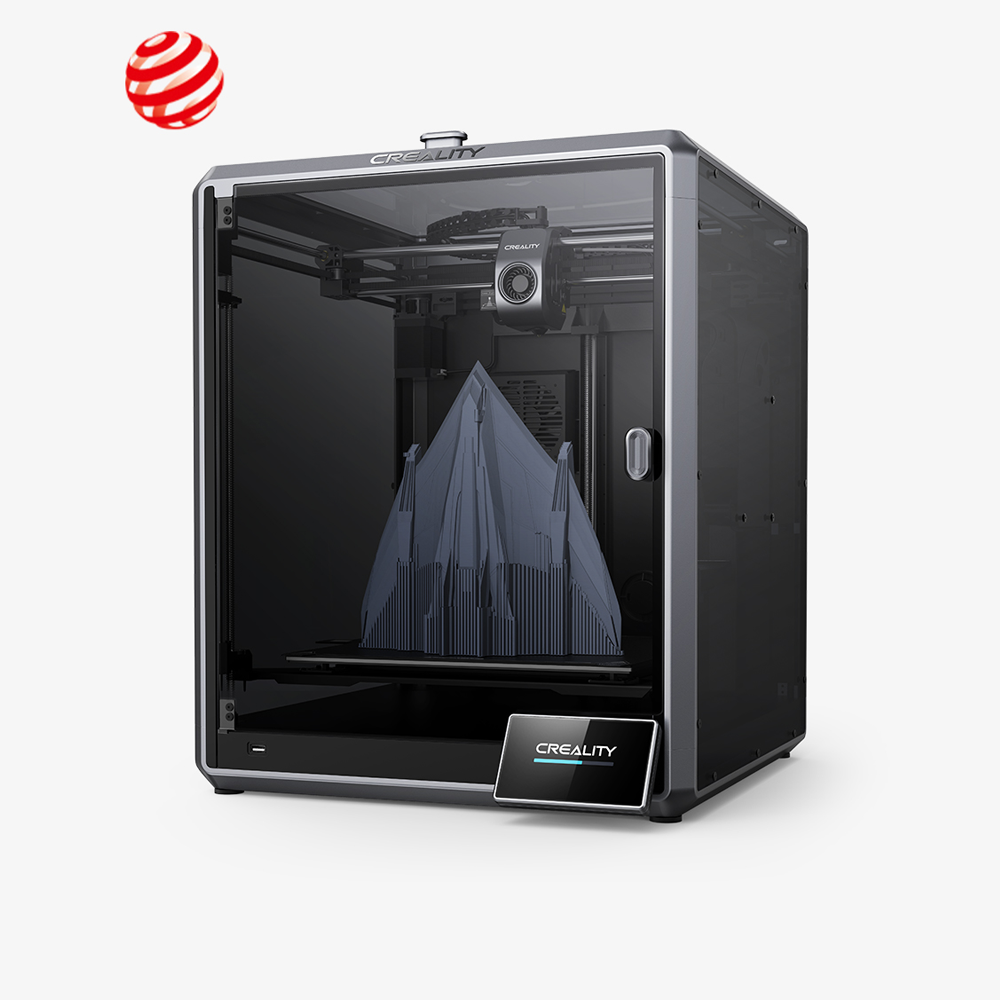
Creality K1 Max
Enclosed 300 mm CoreXY printer rated at 600 mm/s, with an AI camera, LiDAR first-layer scanning and Ethernet.
$549Price checked October 28, 2026
Best for Large single-piece printsBest for Cosplay helmets and propsBest for Small workshops needing EthernetBest for Carbon fiber filled PLA and PETG
Overview
The K1 Max is Creality's large-format enclosed CoreXY printer, with a 300 x 300 x 300 mm volume, 600 mm/s top speed and 20,000 mm/s2 acceleration. It adds an AI camera, AI LiDAR first-layer inspection, a 300 C hardened steel nozzle and Wi-Fi plus Ethernet.
What it is
The K1 Max is the larger sibling of Creality's K1, launched in April 2023. It is an enclosed CoreXY printer with a 300 mm cube build volume, built around speed and automation: hands-free leveling, an AI camera for failure detection and an AI LiDAR sensor that scans the first layer. Creality's US store now sells it as the "K1 Max 2025".
Key specs that matter
- Build volume: 300 x 300 x 300 mm, about 2.2 times the bed area of a 220 mm printer.
- Speed and acceleration: up to 600 mm/s and 20,000 mm/s2, with a typical speed of 300 mm/s and travel up to 800 mm/s per Creality. Creality notes the 600 mm/s figure was reached in Surface Mode at 0.1 mm layer height.
- Hotend: up to 300 C with a hardened steel nozzle, which Creality says heats to 200 C in 40 seconds.
- Heated bed: up to 100 C, with strain sensors in the bed for hands-free auto leveling.
- Monitoring: AI camera for spaghetti, failure and foreign-object detection plus time-lapse, and AI LiDAR with 1 micron resolution that scans the first layer and pauses on problems.
- Connectivity: Wi-Fi, Ethernet (RJ45) and USB drive, with Creality Print and Creality Cloud. 8 GB storage.
- Screen: 4.3 in capacitive touchscreen.
Who it suits
The K1 Max suits makers who need bigger single-piece prints, such as helmets, enclosures, drone frames and large functional parts, and want an enclosed printer that handles leveling and first-layer checks automatically. Ethernet support also makes it practical in workshops or small businesses where Wi-Fi is unreliable. The combination of a large bed and automatic first-layer checks is useful for long jobs, where a failed first layer would otherwise waste hours of print time and a lot of filament. Creality also lists Cura and Simplify3D alongside its own Creality Print slicer.
What to know before buying
- Price has dropped. The official US store lists the K1 Max 2025 at $549, down from a regular $899.
- Enclosed, but not actively heated. The enclosure holds heat from the bed, which helps with ABS and ASA, but there is no chamber heater. Creality's newer K2 Pro and K2 Plus add active chamber heating to 60 C.
- Hardened steel nozzle. This suits abrasive filled filaments such as carbon fiber blends, within the 300 C limit.
- No multicolor. The K1 Max has no built-in multicolor system. If color matters, Creality's K2 series supports its CFS units.
- Large, heavy machine. A 300 mm enclosed CoreXY printer needs a sturdy table and more space than a 220 mm Ender.
- Newer options. Creality's K2 Pro has the same 300 mm volume, active chamber heating and optional CFS, at $599 base or $799 as a Combo on the US store.
Specifications
| Type | FDM |
|---|---|
| Price | $549 |
| Build volume | 300×300×300 mm |
| Max speed | 600 mm/s |
| Multicolor | No |
| Enclosed | Yes |
| Auto bed leveling | Yes |
| Connectivity | Wi-Fi, Ethernet, USB drive, Creality Cloud |
| Noise | Not listed |
| Release year | 2023 |
Pros and cons
Pros
- The 300 x 300 x 300 mm build volume handles helmets, large enclosures and big functional parts in one piece.
- Creality rates it at up to 600 mm/s with 20,000 mm/s2 acceleration on a CoreXY frame.
- An AI camera watches for spaghetti and foreign objects, and records time-lapses for remote monitoring.
- AI LiDAR scans the first layer and can pause the print if it detects problems.
- The 300 C hardened steel nozzle supports abrasive carbon fiber filled filaments.
- Wi-Fi plus RJ45 Ethernet gives a wired connection option that many consumer printers lack.
Cons
- There is no active chamber heater, unlike Creality's newer K2 Pro and K2 Plus, which heat to 60 C.
- There is no multicolor system, so it cannot do automatic color or material swaps.
- The 100 C bed and 300 C nozzle limit some high-temperature engineering materials.
- Its large enclosed frame needs considerably more desk space than a 220 mm class printer.
- Creality's 600 mm/s figure was reached in a special Surface Mode, so typical speeds are lower.
- Newer K2 Pro models at similar prices add chamber heating and CFS support that the K1 Max lacks.
Frequently asked questions
Can the K1 Max print ABS and ASA?
Yes, it has an enclosed chamber, a 300 C nozzle and a 100 C bed. The chamber is warmed only by the bed, not by a heater, so very large ABS parts may still warp more than on an actively heated printer.
Does the K1 Max need assembly?
Creality's US store describes it as ready to use without assembly. Leveling is handled by strain sensors in the bed.
Can the K1 Max print in multiple colors?
No. It has no built-in multicolor system. Creality's K2 series printers support the CFS for multicolor printing.
Does it work with third-party filament?
Yes. It uses standard 1.75 mm filament, and the hardened steel nozzle can handle abrasive filled filaments within its 300 C limit.
What is the K1 Max 2025?
It is the name Creality's US store currently uses for the K1 Max listing. The store page does not publish a separate spec sheet showing differences from the original K1 Max.
Sources
Verdict
The K1 Max is a good fit for buyers who want a 300 mm enclosed printer with camera and LiDAR monitoring at its current $549 sale price. Buyers who want multicolor or active chamber heating for ABS, ASA and nylon should look at the K2 Pro or K2 Plus.
Featured in
Related printers