Creality Ender 3 V3 vs Bambu Lab A1 Mini

Verdict
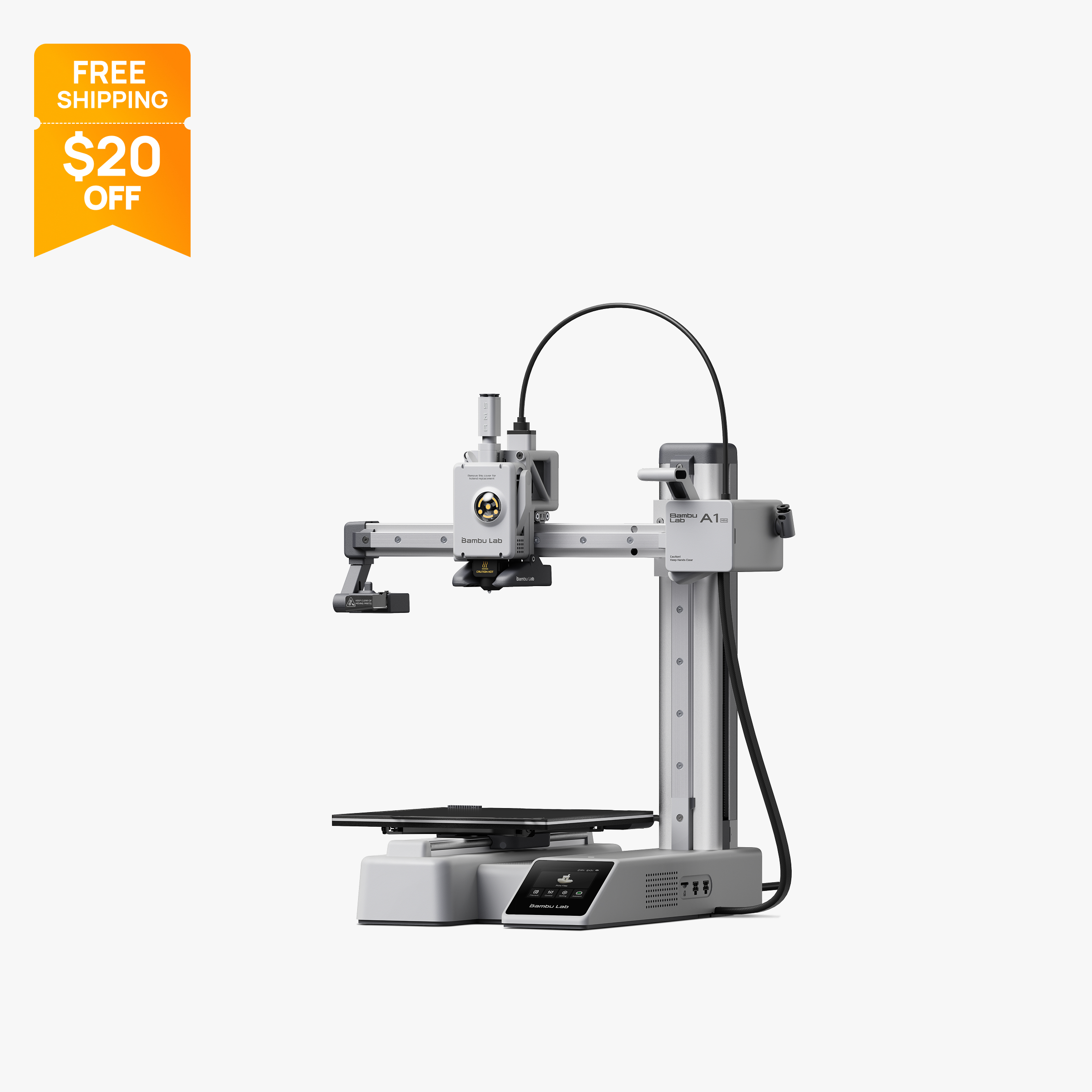
The Ender-3 V3 is sold out on Creality's US store, so this page suits used buyers and owners. It has a bigger 220 x 220 x 250 mm bed, 110 °C bed and 600 mm/s rating; the A1 mini is in stock, adds optional 4-color AMS Lite and is the practical pick for new buyers.
Specs side by side
| Spec | Creality Ender 3 V3 | Bambu Lab A1 Mini |
|---|---|---|
| Type | FDM | FDM |
| Price | Check current price | $199 |
| Build volume | 220×220×250 mm | 180×180×180 mm |
| Max speed | 600 mm/s | 500 mm/s |
| Multicolor | No | Yes (AMS Lite (optional, up to 4 colors)) |
| Enclosed | No | No |
| Auto bed leveling | Yes | Yes |
| Connectivity | Wi-Fi, USB drive, Creality Cloud | Wi-Fi, Bambu-Bus, microSD |
| Noise | Not listed | Not listed |
| Release year | 2024 | 2023 |
Quick answer
The Creality Ender-3 V3 is not available to buy new from Creality's US store right now: its store page is marked Sold Out and it is missing from the 3D printers collection, although the creality.com product page is still live. This page is still useful if you are weighing a used or leftover-stock Ender-3 V3, already own one, or are reading older reviews. On paper the Ender-3 V3 offers more build volume and a hotter bed, while the Bambu Lab A1 mini is in stock and can add multicolor. For most people buying today, the A1 mini is the practical pick, with Creality's newer Ender-3 V4 as the alternative to watch.
Key differences
Availability and successor
Creality's official US store lists the Ender-3 V3 as Sold Out and leaves it out of the 3D printers collection. Creality now lists the Ender-3 V4 as its next-generation Ender, with a 220 x 220 x 235 mm build volume and speeds up to 500 mm/s. No US store price for the V4 was found when this page was written, and the Japan store listed the V4 Combo as sold out, so check Creality's site for current stock.
The A1 mini, by contrast, was listed and in stock on Bambu's US store on October 28, 2026. That matters more than any single spec. A printer you cannot buy new is hard to recommend, and a used one comes without a known history. If you find an Ender-3 V3, treat it as a used or leftover-stock purchase and verify the seller's return policy.
Build volume
The Ender-3 V3 has the larger bed in X and Y and in height: 220 x 220 x 250 mm, against 180 x 180 x 180 mm on the A1 mini. Multiplied out, that is about 12.1 million cubic millimeters against about 5.8 million, roughly twice the volume.
Whether that matters depends on your prints. Figures, small tools, cable clips and desk organizers fit on either printer. A tall vase, a full-size phone stand or a case for a large board fits on the Ender-3 V3 in one piece, and on the A1 mini you may need to scale it down or split it. If you want more room than either offers, the full-size Bambu Lab A1 has a 256 x 256 x 256 mm bed.
Speed and motion
Creality rates the Ender-3 V3 at up to 600 mm/s and 20,000 mm/s² acceleration, which is high for an Ender-series printer. Bambu lists the A1 mini at 500 mm/s and 10,000 mm/s². On paper the Ender-3 V3 is faster and accelerates harder.
These are manufacturer ratings, not measured print times, and the gap between rated and practical speed depends on the model, the slicer profile and how much vibration the frame allows. The A1 mini weighs 5.5 kg and uses Bambu's automatic calibration before each print, and the Ender-3 V3 uses a CoreXZ layout in a compact frame. Both are open-frame machines, so neither is an enclosed speed machine like the Bambu Lab P1S.
Temperatures and materials
Both printers have a 300 °C nozzle. The bed is where they differ: Creality lists a 110 °C bed on the Ender-3 V3, while the A1 mini's bed tops out at 80 °C. Creality's product page lists PLA, PETG, TPU and ABS among supported materials, and the 110 °C bed gives it more headroom for ABS attempts than the A1 mini's 80 °C limit.
However, neither printer has an enclosure. Bambu lists ABS, ASA, PC, PA and fiber-filled filaments as not recommended on the A1 mini, and the Ender-3 V3 is open as well, so ABS and ASA are hard to print well on it without adding an enclosure. In practice both are PLA, PETG and TPU printers. If ABS or ASA matter, see best enclosed 3D printers.
Multicolor
The A1 mini supports Bambu's AMS Lite for up to 4-color printing, either bundled in the Combo or added later. The Ender-3 V3 has no multicolor or multi-material system, so any color change requires a manual filament swap.
If you want to print multicolor figures, signs or logos without swapping spools by hand, this is a decisive point in the A1 mini's favor. If you print single-color functional parts, it will not matter. Our best multicolor 3D printers page covers other options.
Software, screen and connectivity
The Ender-3 V3 has a 4.3-inch color touchscreen, a larger screen than the A1 mini's 2.4-inch touchscreen. Connectivity on the Ender-3 V3 is Wi-Fi, USB drive and Creality Cloud app control, which lets you start and monitor prints remotely. The A1 mini lists Wi-Fi, Bambu-Bus and microSD, and most control happens through the Bambu app or Bambu Studio.
Both printers level the bed automatically. Bambu says the A1 series calibrates Z-offset, bed level, vibration and nozzle pressure before every print. Creality lists hands-free auto leveling on the Ender-3 V3, which removes the manual leveling step older Ender-3 models required.
Creality's Ender-3 V3 has no built-in camera for remote monitoring (Creality sells an optional Nebula Camera), unlike the K1C. This page has no verified camera detail for the A1 mini, so check Bambu's spec page if monitoring matters.
Accuracy and reliability notes
Creality lists printing accuracy of plus or minus 0.2 mm for the Ender-3 V3, which is looser than the figure it publishes for the Ender-3 V3 SE and V3 KE. For the A1 mini, Bambu lists filament run-out, tangle and odometry sensors plus power loss recovery as standard, which is useful on long jobs.
What Creality sells instead
If you like the Ender-3 V3's format but want something Creality still sells, there are alternatives within its own lineup. The Ender-3 V3 SE is the entry-level model: Creality lists a 220 x 220 x 250 mm bed, CR Touch auto leveling and a 250 mm/s top speed, which is slower than the Ender-3 V3's rating, and it costs less. Creality's Ender-3 V3 comparison on its store blog sets the V3, V3 SE and V3 KE side by side if you want the full spec breakdown. The K1C steps up to an enclosed CoreXY design with a hardened steel nozzle and a camera, which fixes two of the Ender-3 V3's biggest limits, though at a much higher price.
The Ender-3 V4 is the newer model Creality names as its next-gen Ender. Its listed 220 x 220 x 235 mm volume is slightly shorter than the V3's 250 mm height. Because no US store price was found, we leave it out of the price section.
Checklist if you are buying a used Ender-3 V3
Since new stock is limited, a secondhand Ender-3 V3 may be your only way to get one. Ask the seller:
- Whether the printer still auto levels and probes the bed reliably, since hands-free leveling is one of its main selling points.
- How the nozzle and hot end have been used and maintained, and whether the nozzle has been replaced.
- Whether the touchscreen, Wi-Fi and USB drive transfer all work, so you are not stuck with a printer that cannot receive files.
- What accessories are included, because the Ender-3 V3 has no multicolor system and you cannot add one later.
Also ask for the purchase date and whether any support or warranty transfers to you; Creality's official pages are the place to confirm current terms. If the answers are unclear or the price is close to a new A1 mini at $199 on sale, the A1 mini is the lower-risk purchase.
Price and what you get
At the time of writing (October 2026), the A1 mini is $199 on sale (regular $219) for the printer alone on Bambu's US store, and the A1 mini Combo, which adds the AMS Lite, is $299 (regular $329). We do not quote a price for the Ender-3 V3 because Creality's US store shows it as Sold Out.
For a current Creality option, the Ender-3 V3 SE is $179 on sale (regular $199) on Creality's US store, and the Creality K1C, an enclosed CoreXY printer, is $499 on sale (regular $559). Prices change, so check the store before buying.
Who should buy which
Consider a used Ender-3 V3 if:
- You find one at a clear discount and can inspect or return it.
- You want the bigger 220 x 220 x 250 mm bed and the 110 °C heated bed.
- You print single-color PLA and PETG parts and like a large touchscreen.
Buy the A1 mini if:
- You want a printer that is in stock and sold by its maker.
- You want to add 4-color printing with the AMS Lite.
- You want automatic calibration before each print, and the lowest-priced printer in Bambu's US lineup.
Also consider
- The Bambu Lab A1 if you want a larger bed than either machine; see A1 vs A1 mini.
- The Creality Ender-3 V3 SE for the cheapest current Ender; see best 3D printers under $200.
- Creality's newer Ender-3 V4 once it is in stock in your region.
For a first printer, read best 3D printers for beginners and the cheapest 3D printers guide.
Frequently asked questions
Is the Creality Ender-3 V3 still sold?
Creality's US store lists it as Sold Out and it is absent from the 3D printers collection, though the creality.com product page is still live. Creality now lists the Ender-3 V4 as its next-generation Ender.
Which has a bigger build volume, the Ender-3 V3 or the A1 mini?
The Ender-3 V3, at 220 x 220 x 250 mm against 180 x 180 x 180 mm on the A1 mini. That is roughly twice the volume. The full-size Bambu Lab A1 has a 256 mm cube.
Is the Ender-3 V3 faster than the A1 mini?
On paper, yes. Creality rates it at up to 600 mm/s and 20,000 mm/s², while Bambu lists 500 mm/s and 10,000 mm/s² for the A1 mini. These are manufacturer ratings, not measured print times.
Can the Ender-3 V3 or A1 mini print multicolor?
The A1 mini can with the optional AMS Lite, up to 4 colors. The Ender-3 V3 has no multicolor system, so color changes need a manual filament swap.
Can either printer print ABS?
Neither is enclosed. Bambu lists ABS and ASA as not recommended on the A1 mini, and the Ender-3 V3's 110 °C bed gives it more headroom for ABS attempts but it is open as well. For ABS or ASA, look at an enclosed printer.
What should I buy instead of the Ender-3 V3?
For a Bambu option, the A1 mini is $199 on sale at the time of writing (October 2026). From Creality, the Ender-3 V3 SE is $179 on sale and the enclosed K1C is $499 on sale, and the Ender-3 V4 is the newer Ender to watch.
Sources
- Creality Ender-3 V3 product page (official)
- Creality US store, Ender-3 V3 listing (official)
- Creality store blog: Ender-3 V3 vs V3 SE vs V3 KE spec comparison (official)
- Creality US store, 3D printers collection (official)
- Creality Ender-3 V4 product page (official)
- Creality US store, Ender-3 V3 SE (official)
- Bambu Lab A1 mini tech specs (official)
- Bambu Lab A1 mini on the official US store (price)
- Bambu Lab AMS lite on the official US store (price, compatibility)